
Bottom line: HME resupply is recurring revenue that depends on timing, eligibility, and documentation being right for every patient on every cycle.
Manual tracking does not scale, so orders get missed and revenue slips. Rules-based automation generates and validates routine orders and routes the exceptions to staff.
What is HME resupply?
HME resupply is the recurring replacement of consumable supplies for patients on ongoing therapy: PAP masks, tubing, and filters for sleep patients, sensors and transmitters for CGM, and supplies for wound care, oxygen, and other long-term programs. Each patient has a billing window, a set of quantity limits, and coverage rules that have to be current for the order to pay.

Unlike a one-time order, resupply repeats for the life of the therapy. One PAP patient can generate dozens of orders over a few years. Multiply that across a growing panel and resupply becomes the largest recurring source of orders in many HME operations, and the one most exposed to small, repeated process failures.
Sometimes, Resupply Revenue Slips Through Manual Processes
Resupply is a timing and eligibility problem at scale. Every patient is on a different cycle, and the work to confirm each order (is the patient due, is coverage still active, are they within quantity limits, is documentation current) is the same set of checks repeated thousands of times. Done by hand, that work does not keep pace with a growing panel.
The revenue slips in quiet ways:
- Patients who are due are never contacted, so the order is never generated
- Orders go out for patients whose coverage lapsed, and the claim denies
- Quantity limits are exceeded because no one checked the last billed date
- Reauthorization intervals pass unnoticed, stalling future orders
- Compliance requirements for PAP are not met, so the claim cannot bill
None of these are dramatic. Each is one missed check on one patient. But across a full panel, they add up to recurring revenue that was available and never captured.
What Does Effective HME Resupply Require From Your Operation?
Running resupply well means getting the same things right on every cycle, for every patient, without depending on anyone to remember. That is a workflow problem before it is a staffing problem.
Each cycle, a resupply order needs:
- Confirmation the patient is within their billing window for the item
- Active coverage and benefit verification for the date of service
- Quantity and frequency within the plan's limits
- Current documentation and, for PAP, any required compliance data
- Reauthorization checked and in place when the interval requires it
- Patient contact to confirm need and consent before dispensing
When these are verified before the order ships, resupply bills cleanly and predictably. When they are assumed, the operation generates denials and write-offs on what should be its most reliable revenue.
How Automation Can Dramatically Improve HME Resupply
Rules-based resupply automation treats resupply as what it is: a repeating set of checks that can be defined and applied consistently.
It identifies which patients are due, confirms coverage and benefit eligibility, checks the last billed date against quantity limits, verifies documentation and compliance requirements, and flags reauthorization before it lapses.
Orders that pass every check are generated and advanced automatically. Orders that fail route to an exception queue with the reason attached: coverage lapsed, compliance not met, reauthorization needed, or documentation missing. Staff work the exceptions instead of manually screening every patient to find the few that need attention.
This is where resupply scales. The same team manages a larger active patient panel because they are no longer tracking cycles and checking eligibility one patient at a time. Their time goes to patient contact, noncompliant PAP outreach, and the coverage problems that need a person. This layers onto existing Brightree workflows rather than replacing them, and ties order generation to validated conditions instead of a manual review that gets skipped under load.
Manual Resupply VS. Automated Resupply
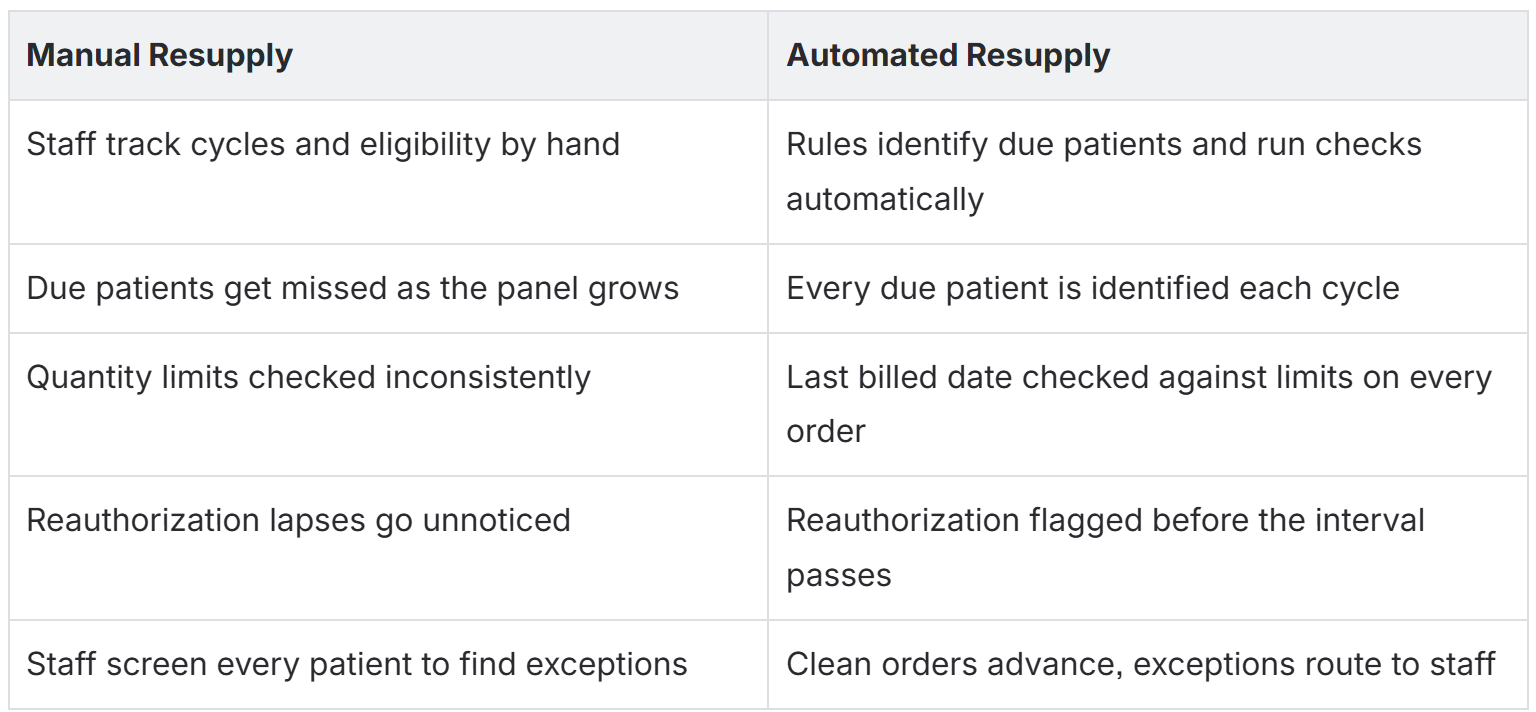
Automation does not remove the patient relationship. It removes the manual tracking so staff can spend more time on the patient contact that actually drives resupply compliance.
HME Resupply FAQs
What does HME resupply automation actually automate?
It automates the repeatable checks: identifying patients who are due, confirming eligibility, checking quantity limits against the last billed date, verifying documentation and compliance, and flagging reauthorization. Orders that pass advance automatically; those that fail route to staff with the reason.
Is resupply automation the same as touchless resupply?
Not exactly. Touchless describes routine orders progressing without manual intervention. In practice, a well-run program is touchless for clean orders and routes exceptions (lapsed coverage, missing compliance, needed reauthorization) to staff. The goal is fewer manual touches, not zero human judgment.
Does resupply automation require replacing Brightree?
No. It layers rules-based order generation, eligibility checks, and exception routing onto existing Brightree workflows. Brightree stays the system of record while automation applies broader validation and ties order status to real conditions.
How does automation prevent resupply denials?
It confirms coverage, quantity limits, documentation, and compliance before the order ships, so the defects that cause resupply denials are caught before fulfillment rather than discovered at billing.
Can a small HME team benefit from resupply automation?
Yes. Lean teams benefit most, because manual cycle tracking is where a small staff loses the most recurring revenue. Automation lets the same team manage a larger panel without adding people to keep pace.
Where to Start
You do not need to automate the whole program at once. Start with the largest recurring program and the clearest revenue leak.
- Pick your highest-volume resupply program, usually PAP.
- Pull the last 60 to 90 days of resupply denials and missed cycles.
- Sort by cause: lapsed coverage, quantity limits, compliance, reauthorization, or no contact.
- Rank those patterns by volume and revenue impact.
- Configure rules for due-date identification, eligibility, and quantity checks on that program.
- Route failures to an exception queue with the reason attached.
- Confirm the results, then extend to the next program.
Resupply is the most predictable revenue an HME operation has, and the easiest to lose a little at a time. Making the recurring checks consistent is how you capture the orders that are already yours.
