
Bottom line: Outsourced DME RCM services hand your billing and collections to a third party, which adds capacity fast and feels like a fix. That's not always the case.
Most denials come from upstream defects a vendor can't touch, so you keep paying a percentage of every dollar to work claims that shouldn't have been dirty in the first place.
Our advice? Fix the cause before you rent the labor.
What Are Outsourced DME RCM Services?
Outsourced DME RCM services are third-party companies that run some or all of your revenue cycle for you. Depending on the vendor and the contract, that can mean claim submission, payment posting, denial follow-up, A/R collections, and appeals, sometimes handled onshore and often offshore. You keep the patients and the contracts; the vendor works the claims for a fee, usually a percentage of collections or a per-claim rate.
Providers turn to outsourcing for real reasons. Billing is hard to staff, turnover is constant, and a vendor brings people and coverage without the cost of hiring in-house. When a billing team is underwater, outsourced RCM services can clear a backlog and steady cash flow for a while. But that relief comes with a standing tax on collections and a growing distance from your own revenue cycle, and it does nothing about why the claims were denied in the first place.
What Do Outsourced DME RCM Services Actually Fix?
Outsourcing solves one main problem: capacity.
It puts more hands on claim submission, follow-up, and collections than you could staff yourself, and it converts a fixed payroll cost into a variable one. For an operation that can't hire fast enough or can't keep billing seats filled, that's a real short-term relief.
Notice what that relief costs. It's a percentage of collections that never goes away, so the fee grows as you grow, and it buys capacity on the back end, which is the wrong end. It gets claims worked faster without making them any cleaner.
What Outsourcing Doesn't Fix
Here's the part that gets missed.
Outsourcing changes who works the claim. It doesn't change the condition the claim is in when it arrives.
Most DME denials come from defects created upstream, at intake and fulfillment, before billing ever touches the order. A biller, in-house or offshore, can't create a face-to-face note that was never captured, obtain an authorization that was never requested, or fix a proof of delivery missing a signature.
So when the upstream process keeps producing incomplete orders, outsourcing moves the symptom without touching the cause. The vendor works denials that shouldn't exist, appeals claims that were defective from the start, and bills you a percentage for the effort. Your collections may tick up because more hands are working the backlog, but the same gaps keep refilling it. You've hired someone to bail the boat instead of patching the hole.

Then there's the incentive problem, and it's the one operators underestimate. A vendor paid a percentage of collections has no reason to shrink the denial volume that feeds its fee. The messier your claims, the more there is to work, and the more it bills. The party best positioned to notice your recurring intake gaps is the party that profits from them continuing. Even a well-meaning vendor isn't paid to go fix your intake process.
Distance makes it worse. When the people working your claims sit outside your operation, often offshore and rotating through turnover of their own, the feedback loop between a denial and its upstream cause stretches thin. The team that could actually fix the intake gap rarely hears which gap keeps causing the denials, so the defect repeats indefinitely. Over time you don't just outsource the work, you lose the institutional knowledge of your own revenue cycle and grow dependent on a vendor you can't easily replace.
Outsourced DME RCM Services vs. Rules-Based Automation
These aren't opposites, and the honest framing is that they solve different problems. Outsourcing adds capacity to work claims. Rules-based automation reduces the defects that create the work in the first place by validating each order at intake, before it becomes a claim.
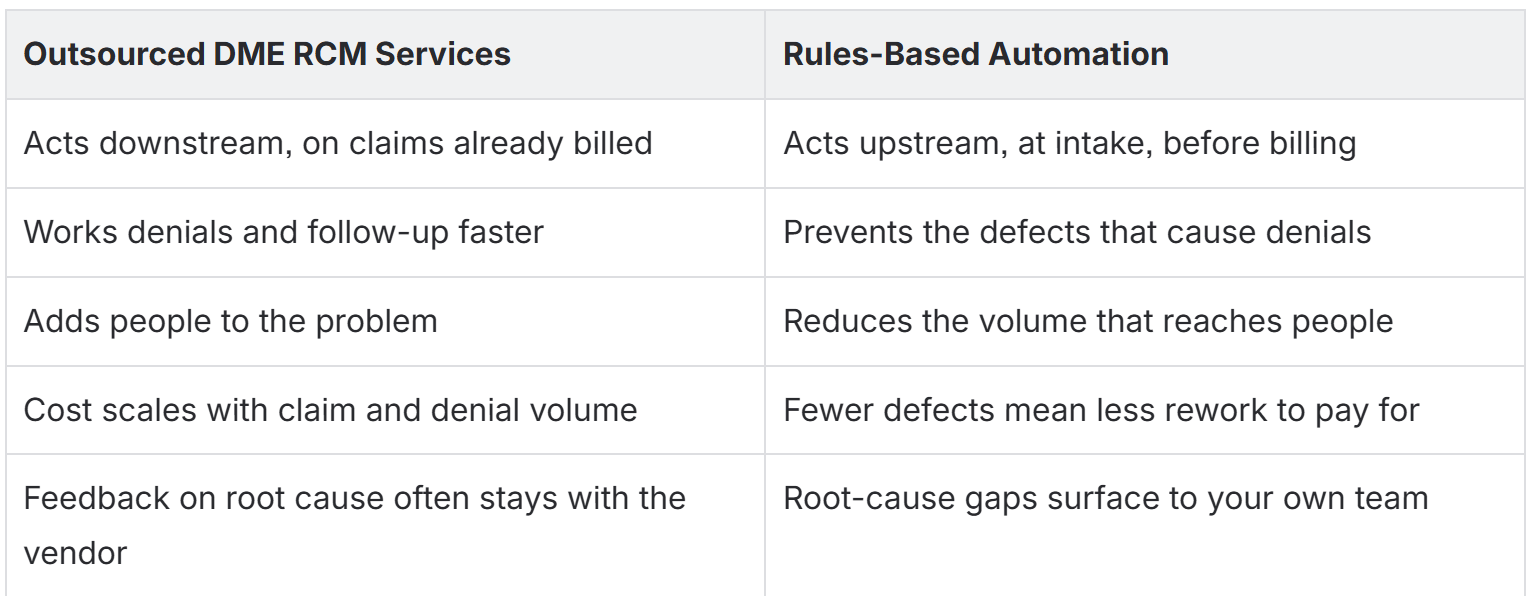
The practical point is that automation improves the inputs no matter who works the claims. Validate documentation, eligibility, authorization, and coding at intake, and fewer defective claims enter the cycle. If you keep billing in-house, your own team handles more volume with fewer manual touches. If you outsource, your vendor works cleaner claims, which means fewer denials to chase and less collected against a percentage. Either way, fixing the cause makes the model you choose work better.
This layers into your existing system. If you run Brightree, the validation can drive WIP routing inside the workflow you already use, so an order can't reach a billable state until it's clean. A status tracker becomes a workflow engine only when the state changes are tied to validated conditions instead of a manual click.
Outsourced DME RCM Services FAQs
What do outsourced DME RCM services typically include?
It varies by vendor, but usually some mix of claim submission, payment posting, denial follow-up, A/R collections, and appeals, billed as a percentage of collections or a per-claim fee. Some vendors handle the full cycle; others take only the pieces you can't staff.
Does outsourcing RCM reduce denials?
It can help you work denials faster, but it doesn't prevent them. Most denials come from upstream documentation and authorization gaps. Outsourcing puts more people on the claims without changing the intake process that creates the defects.
Can you outsource billing and still automate?
Yes, and the two work well together. Automating validation at intake means whoever works your claims, in-house or outsourced, works cleaner ones. Automation improves the inputs; outsourcing supplies capacity on the output.
Does automating upstream require replacing Brightree?
No. Rules-based validation and routing run inside your current Brightree workflows as an added layer, not a platform swap, whether or not you also use an outsourced RCM partner.
Where to Start
Before you sign or renew an outsourcing contract, understand what you'd actually be handing off.
- Pull 60 to 90 days of denials and sort them by root cause.
- Separate the denials that come from upstream gaps from the ones that are true billing complexity.
- Fix the upstream causes with intake validation so those defects stop entering the claim stream.
- Size what's left: the genuine billing volume and complexity a vendor or your own team would work.
- Decide the model on clean numbers, whether to outsource, keep it in-house, or combine them.
- Whichever you choose, tie WIP state changes to validated conditions so claims arrive clean.
- Track denials and collections, then adjust once the upstream fixes take hold.
Outsourcing can bridge a genuine capacity gap in the short term. As a long-term answer, it's expensive, it's misaligned with your interests, and it leaves the real problem untouched while your revenue cycle drifts further out of your hands. Fix the cause first. Most of what you were about to outsource disappears when the claims stop being dirty, and whatever billing work is left is yours to keep, at a cost that doesn't scale with every dollar you collect.
