

Bottom line: A Medicare Advantage audit tests whether the documentation behind your claims actually supports what you billed.
You can't build that record after the request arrives, because the encounter, the order, and the delivery already happened.
The way to prepare is to make every order audit-ready at intake, before it's ever billed.
What Is a Medicare Advantage Audit?
A Medicare Advantage audit is a review of whether the claims paid under an MA plan are supported by documentation. The term covers two different things, and it helps to separate them.
At the top, CMS runs Risk Adjustment Data Validation, or RADV, audits of the Medicare Advantage organizations themselves.
RADV checks whether the diagnoses a plan submitted for risk adjustment are supported in the patient's medical record, and CMS uses it to recover overpayments from plans. CMS has moved to expand these audits, which pushes plans to tighten the documentation they demand from the providers and suppliers they contract with.
For a DME supplier, the audit you actually prepare for is the one that lands on your desk: a Medicare Advantage plan, or a contractor working on its behalf, requesting the records behind specific claims. The pressure from the top flows down to you as stricter documentation review, and the file you can produce is what determines whether the payment stands.
What Does a Medicare Advantage Audit Check?
An MA audit works backward from a paid claim to the evidence. For DME, that evidence is the same chain that supports medical necessity and payment in the first place, and each link has to be present and consistent.
- A valid, complete order from the treating practitioner, with every required element and a signature
- A face-to-face encounter within the required window when the item calls for one, documented in a note that addresses the ordered equipment
- Chart notes and clinical documentation that support medical necessity for the specific item
- Prior authorization or plan approval when the plan requires it, captured before fulfillment
- Proof of delivery in the correct format for how the item was delivered
- Coding and modifiers that match the documentation, plus any plan-specific rules that differ from traditional Medicare
The plan-specific piece is where MA differs from traditional Medicare. A Medicare Advantage plan can set its own coverage criteria, authorization triggers, quantity limits, and documentation thresholds, so a record that would satisfy traditional Medicare can still fail a plan's audit if it misses that plan's rule.
Why DME Suppliers Fail Medicare Advantage Audits
Most audit failures aren't discovered during the audit. They were created months earlier, at intake or fulfillment, and the audit just surfaced them. The order went out missing a face-to-face note.
The proof of delivery lacked a signature. The plan required an authorization that nobody captured. Each gap passed quietly at the time and became a finding when the record was pulled.
Audit readiness is the output of daily process quality, not a project you start when a request arrives. If your documentation is complete and consistent on every order as a matter of routine, an audit is a retrieval exercise.
If it isn't, an audit is a scramble to reconstruct records that may no longer be fixable, because the compliance condition was supposed to be met before the claim, not after. Billing can't manufacture a signature that was never collected or an authorization that was never obtained.
How to Keep Documentation Audit-Ready
The reliable way to prepare for a Medicare Advantage audit is to stop treating readiness as a separate task and build it into the workflow. Rules-based automation validates each order against the requirements at intake, so the record is complete before the claim goes out and stays retrieval-ready if it's ever requested.
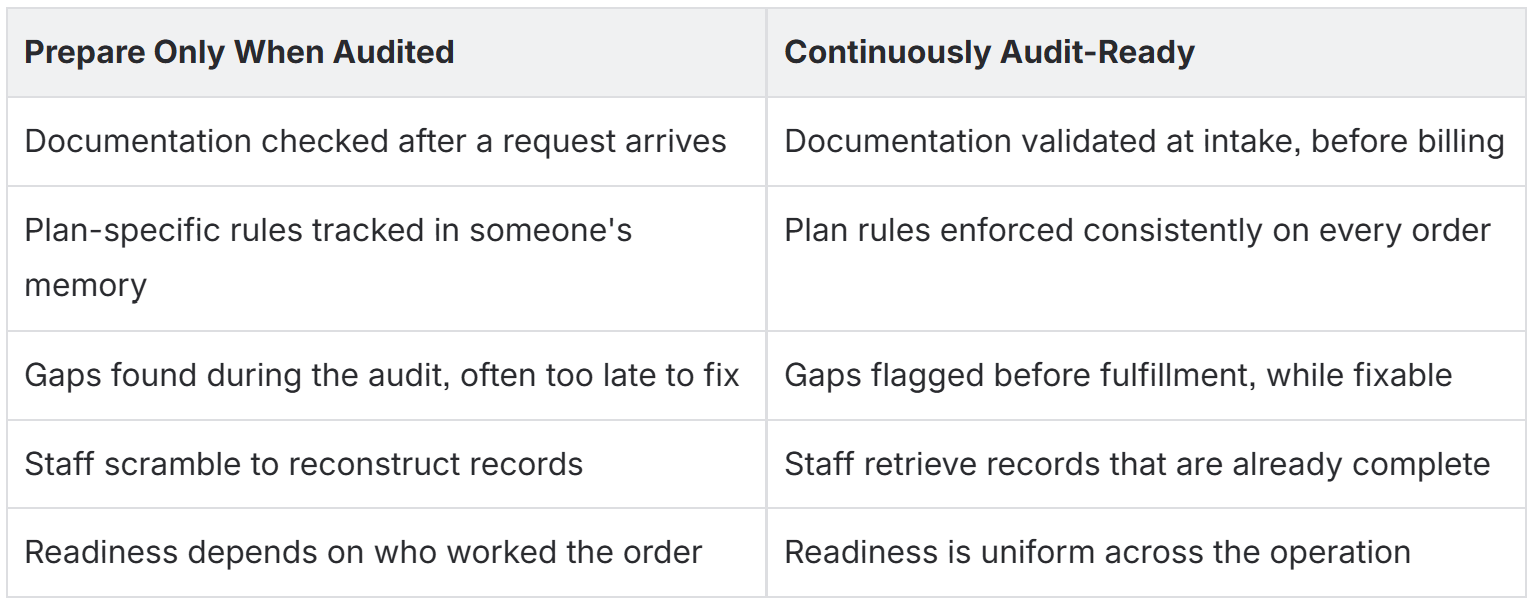
In practice, automation confirms the order is complete, checks that a face-to-face encounter and medical-necessity documentation are on file when required, verifies plan-specific authorization and coverage rules, and confirms the proof of delivery carries the right elements. Orders that pass are audit-ready by default. Orders that fail route to an exception queue with the specific gap attached, so staff fix the record while the fix is still possible.
This layers into your existing system. If you run Brightree, the validation can drive WIP routing inside the workflow you already use, so an order can't reach a billable state until its documentation would survive a review. A status tracker becomes a workflow engine only when the state changes are tied to validated conditions instead of a manual click.
Medicare Advantage Audits FAQs
What triggers a Medicare Advantage audit for a DME supplier?
Plans and their contractors select claims for review in different ways, often by item, by dollar value, by billing pattern, or at random. Because you can't predict which claims get pulled, the practical answer is to keep every order's documentation complete rather than guessing which ones will be reviewed.
How is a Medicare Advantage audit different from a traditional Medicare audit?
The documentation chain is similar, but MA plans can set their own coverage criteria, authorization rules, and documentation thresholds. A record that satisfies traditional Medicare can still fail a plan's audit if it misses that plan's specific requirement.
How far back can a Medicare Advantage audit reach?
Records can be requested well after payment, which is why documentation has to be retained and retrieval-ready long after the claim is paid. Keep the full record intact for the retention period, not just until the claim clears.
Does preparing for MA audits require replacing Brightree?
No. Documentation validation and plan-rule enforcement can run inside your current Brightree workflows as an added layer, not a platform swap.
Where to Start
You don't need to audit-proof every claim at once. Start with the plans and gaps most likely to cost you.
- Identify your top Medicare Advantage plans by claim volume.
- Pull 60 to 90 days of denials and past audit findings to see which documentation gaps recur.
- Map each plan's specific rules that differ from traditional Medicare: authorization, coverage, quantity limits, and documentation thresholds.
- Configure intake validation for those rules so orders can't advance until the record is complete.
- Route incomplete records to an exception queue with the specific gap attached.
- Confirm retention and retrieval so requested records can be produced quickly.
- Monitor findings and denials for those plans, then expand once the rules hold.
A Medicare Advantage audit is something you win by being ready for because the documentation was right before the claim ever went out.
