
Bottom line: An HME management system is the software that runs a home medical equipment operation, from intake through billing and resupply.
Most systems track work well but don't enforce the rules that keep orders clean. The gap between tracking and enforcing is where denials, delays, and manual touches come from.
What Is An HME Management System?
An HME management system is the core software an HME or DME provider uses to run daily operations. It's the system of record that holds patient and order data, moves an order from intake through fulfillment and billing, tracks inventory, manages recurring resupply, and reports on the numbers that tell you how the business is running.
For many operations, Brightree fills this role.
A capable system does a lot. It stores documentation, tracks order status through work-in-progress states, generates claims, and gives managers visibility into queues and aging. What it generally doesn't do on its own is enforce the payer-specific and item-specific rules that decide whether each order is actually clean before it advances. That enforcement is a different job, and it's the one that protects revenue.
What Should an HME Management System Handle?
The system of record is where the operation lives, so it has to cover the full order lifecycle without forcing staff into side spreadsheets. At a working level, that means a few things it should do well.
- Hold intake documentation, orders, and eligibility information in one place tied to the patient and order
- Track order status through WIP states so managers can see where work sits
- Generate and submit claims, and support the billing and A/R follow-up that comes after
- Run recurring resupply for PAP, CGM, and similar programs, including billing windows and quantity limits
- Report on queues, aging, denials, and throughput so leaders can see patterns
These are table stakes, and most established systems handle them. The problem isn't that the system fails to track the work. It's that tracking and enforcing are different, and a status field only reflects what someone last clicked.
Where the HME Management System Alone Falls Short
WIP states, worklists, and status dropdowns create visibility only when they reflect reality. If moving an order to "ready to bill" depends on a person remembering to check the documentation, the queue can look organized while holding orders that aren't actually clean. The status says ready. The order isn't. Billing inherits the difference and finds out at the payer.
That's the recurring gap. The system records that a step happened without validating that the step was done correctly. Documentation gets marked complete when a required element is missing. An order advances without confirming the item's payer rules are met. Eligibility is assumed rather than checked. Each of these is a defect the system happily tracks forward, and each one surfaces later as a denial, a stalled order, or a claim someone has to rework. A management system tells you where an order is. It doesn't, by itself, tell you whether the order is right.
How Rules-Based Automation Extends the System
Rules-based automation is the layer that turns a tracking system into a workflow engine. It doesn't replace the HME management system, and it doesn't require ripping out Brightree. It works on top of what you already run, applying the same checks to every order and advancing only the ones that pass.
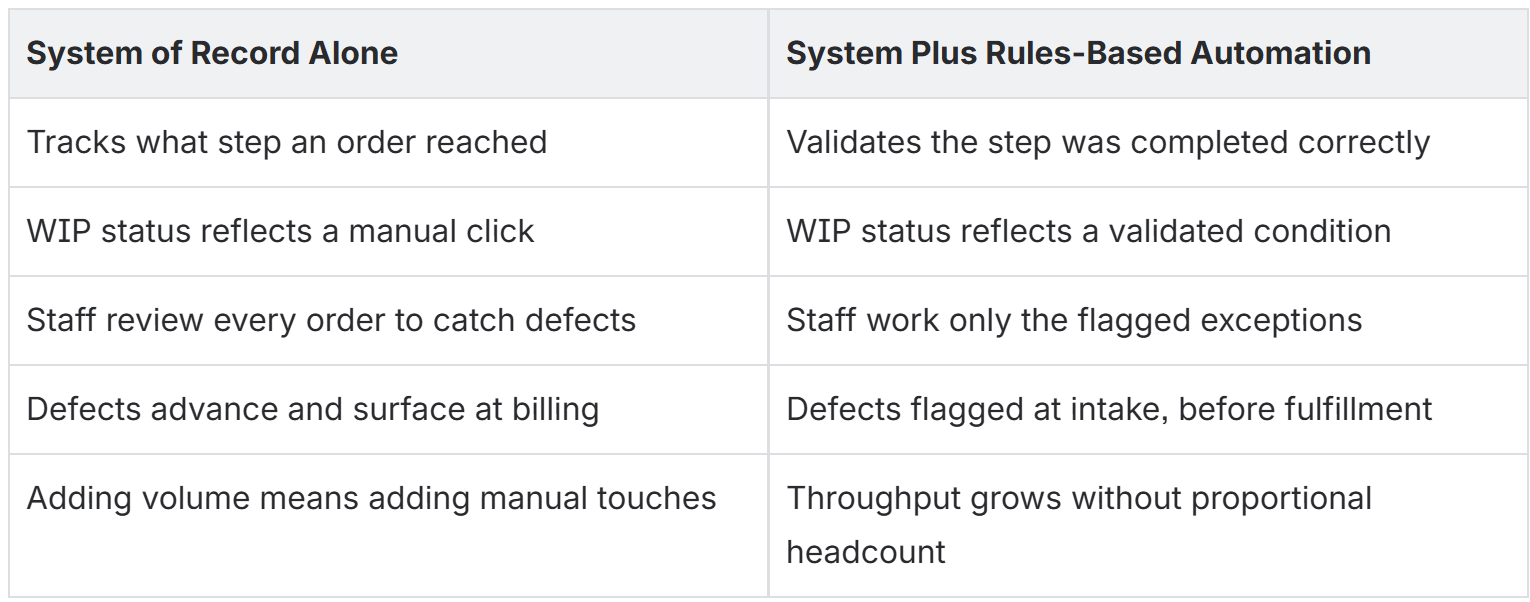
In practice, the automation layer validates documentation completeness, confirms eligibility and benefits, identifies when prior authorization is required, matches items against payer rules, checks coding and modifiers, and routes anything that fails to an exception queue with the specific gap attached. Clean orders move forward on their own. Staff spend their time on the exceptions that need judgment, referral-source outreach, and patient-facing work rather than re-checking orders that are already fine.
The payoff is capacity. The same team manages a larger active patient population because the routine, rules-based work stops landing on a person's desk. A status tracker becomes a workflow engine only when the state changes are tied to validated conditions instead of a manual click.

HME Management Systems FAQs
What is the difference between an HME management system and RCM automation?
The management system is the system of record that runs and tracks the operation. RCM automation is a rules-based layer that validates orders, prevents denials upstream, and prioritizes billing and A/R work. One holds the workflow; the other enforces the rules inside it.
Does adding automation mean replacing our HME management system?
No. Rules-based validation and exception routing can run on top of your current system, including Brightree, as a layer that extends it rather than a platform you have to swap.
Can a small HME operation benefit from automating on top of its system?
Yes. Smaller teams often feel manual touches most, since every order competes for limited staff time. Automating routine validation lets a small team handle more volume without adding headcount.
What should we evaluate first when improving our system?
Start with the workflow stage generating the most denials or stalled orders, usually intake documentation, eligibility, or authorization, and add validation there before expanding.
Where to Start
You don't need to replace your system to get more out of it. Start where the manual work concentrates.
- Identify the workflow stage that generates the most denials, rework, or stalled orders.
- Review 60 to 90 days of denials and WIP data to find the top patterns by volume and revenue.
- Trace each pattern to its upstream cause, usually a validation that a person is doing by hand.
- Configure rules-based validation at that point so orders can't advance until the condition is met.
- Route failures to an exception queue with the specific gap attached.
- Tie WIP state changes to those validated conditions so status reflects reality.
- Monitor denials and throughput, then expand once the rules hold.
An HME management system that tracks work is the foundation. The operations that scale are the ones that make it enforce the rules too, so the same team moves more volume with fewer touches and less rework.
