
Bottom line: DME proof of delivery is the record that shows a patient received the billed item - and it's one of the first things a contractor asks for on review.
When the record is missing an element or was never captured, a paid claim becomes a takeback. Validate proof of delivery at fulfillment, before the claim goes out.
What is DME Proof of Delivery (POD)?
DME proof of delivery, or POD, is the documentation that a patient received the equipment a supplier billed. It's a Medicare supplier standard, and it functions as the evidence behind the claim.
If a contractor requests the file and the POD isn't there or isn't complete, the service is denied regardless of whether the item was medically necessary or delivered in good faith.
The reason POD carries so much weight is that it's the last link in the chain. The order can be valid, the documentation can support medical necessity, and eligibility can be confirmed, and none of it matters at payment if you can't show the item reached the patient. What a complete record has to contain depends on how the item was delivered.
What Does DME POD Have to Include?
Every delivery record has to connect one patient to one item on a specific date. That means the beneficiary's name, the delivery address, a description of the item (a narrative, the HCPCS code, or the brand and model), the quantity, and the date of delivery.

When the supplier hands the item over directly, the record also needs the signature of the beneficiary or a designee.
The designee rule is where clean-looking records quietly fail.
Someone other than the patient can sign, but that person can't be an employee of the supplier or anyone with a financial interest in the delivery, and the relationship should be noted next to a legible signature. A delivery ticket with an unreadable scrawl, no printed name, and no relationship is the kind of gap that passes on the day of delivery and fails a CERT review a year later.
Delivery Method MATTERS for DME Proof of Delivery
Medicare recognizes three delivery methods, and each one sets its own documentation and its own date of service. The date of service matters because it drives the billing window and the claim edits behind it.
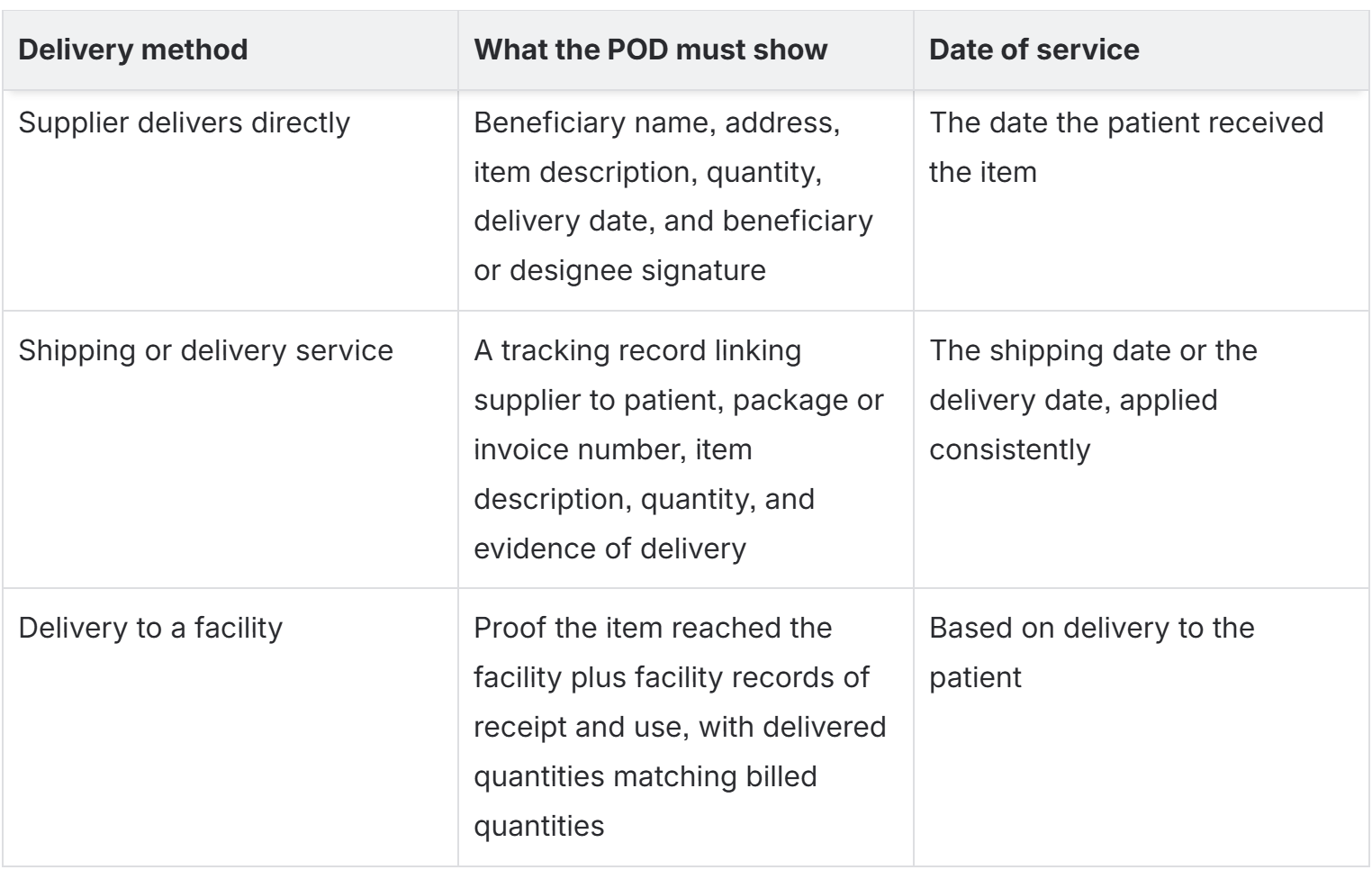
Suppliers have to keep POD for seven years from the date of service. That's the part teams underestimate. A claim billed cleanly today can be pulled for review years out, and the delivery record is what has to answer for it.
Why DME Proof of Delivery Fails
POD lives at the seam between fulfillment and billing, and that's where records slip. The item ships, someone bills it, and the delivery documentation is either incomplete or never captured in a form that holds up. Billing can't create a signature that was never collected or reconstruct a delivery date nobody wrote down.
The failures track the method. Direct deliveries go out without a signature, or with one that has no name and no noted relationship. Shipped items get billed against a tracking record that doesn't clearly tie the carrier's delivery back to the supplier's order. Facility deliveries show a drop-off but no proof the patient received and used the item, and the billed quantity doesn't match what was delivered. None of these surface until the file is requested, and by then the equipment is long gone and the window to fix the record has closed.
A POD denial is a workflow gap that shows up as a billing problem. The record was supposed to be complete before the claim advanced, and it wasn't.
How Automation Validates POD BEFORE Billing
Rules-based automation checks the delivery record against its method before the claim can advance. It doesn't sign tickets or capture signatures. It confirms the documentation exists, matches the delivery method, and carries the required elements, then routes anything short of that to staff.
In practice, automation confirms the delivery method is recorded, checks the POD for the elements that method requires, verifies the date of service matches the delivery evidence, and confirms delivered quantities match billed quantities. Records that are complete move the order forward. Records missing a signature, a date, or a tracking link route to an exception queue with the specific gap attached, so staff chase the one missing piece instead of re-reading deliveries that already pass.
This layers into your existing system. If you run Brightree, POD validation can drive WIP routing inside the workflow you already use, so an order can't reach a billable state until the delivery record supports it. A status tracker becomes a workflow engine only when the state change is tied to a validated condition instead of a manual click.
DME Proof of Delivery FAQs
What counts as DME proof of delivery?
Documentation that ties the patient to the delivered item on a specific date. Direct delivery needs the beneficiary or designee signature; shipped items need a tracking record that links the supplier to the patient and shows evidence of delivery.
What are the required elements of a POD?
Beneficiary name, delivery address, item description, quantity, and date of delivery, plus a beneficiary or designee signature for direct delivery. The item description has to appear on the record itself.
How long do we keep DME proof of delivery?
Seven years from the date of service. A claim can be reviewed well after payment, and the POD is what supports it during that window.
Does validating POD require replacing Brightree?
No. POD validation and routing can run inside your current Brightree workflows as an added layer, not a platform swap.
Where to Start With Automated DME Proof of Delivery:
You don't need to rebuild fulfillment at once. Start where the takebacks cluster.
- Pull 60 to 90 days of denials and audit results tied to proof of delivery.
- Sort them by delivery method to see whether direct delivery, shipping, or facility delivery drives the gaps.
- Trace each denial to its cause, usually a missing signature, an unrecorded date, or a weak tracking link.
- Configure validation at fulfillment for each method: required elements, date of service, and quantity match.
- Route incomplete records to an exception queue with the specific gap attached.
- Monitor the denial and takeback rate for those patterns, then expand once the rules hold.
DME proof of delivery isn't proven at billing. It's proven at the door. And the teams that validate the record before they bill stop giving revenue back on review.
