
Bottom line: DME documentation requirements decide whether a claim is clean long before it reaches billing.
When the order, medical necessity, prior authorization, and proof of delivery are captured and validated at intake, preventable denials never enter the downstream workflow. Automation makes those checks consistent without asking staff to review every routine order by hand.
What Are DME Documentation Requirements?
DME documentation requirements are the records a provider must hold to show that an item was ordered correctly, medically necessary, authorized when required, and delivered to the patient.
For Medicare DMEPOS, that starts with a standard written order (SWO) that carries the patient's name, the order date, a description of the item, and the treating practitioner's name and signature. Behind the order sits the patient's medical record, which has to support medical necessity for the specific item billed.
Requirements vary by item and by payer. Some products need a documented face-to-face encounter within a set window. Some need prior authorization before delivery. Commercial plans often add their own forms, coverage criteria, and diagnosis rules on top of the Medicare baseline.
The point is to make sure the right pieces are present and consistent before the order moves forward.
Why Do Documentation Gaps at Intake Become Denials at Billing?
A denial is usually the visible end of a problem that started upstream. When documentation is incomplete or inconsistent at intake, nothing downstream fixes it. Billing can submit a clean claim, but it cannot create a face-to-face note that was never collected or correct a diagnosis code the referral never supported.
The cause-and-effect chain is direct:
- Missing signature or order date on the SWO leads to a claim rejected for an invalid order.
- Medical record that doesn't support the item leads to a medical necessity denial.
- Missed prior authorization before fulfillment leads to difficult-to-recover revenue after delivery.
- Diagnosis code that doesn't match payer policy leads to a coverage denial.
Each of these is a documentation defect present at intake that surfaces weeks later, after the equipment is already out the door. By then the fix means outreach, rework, and delayed cash flow, and sometimes the revenue is gone.
The Core Documents Every DME Order Needs:
Most orders share a common documentation set. The exact requirements depend on the item and payer, but this is the working checklist for a complete file:
- A standard written order with all required elements and a valid practitioner signature.
- Medical record notes that support medical necessity for the item billed.
- Face-to-face encounter documentation when the item or payer requires it.
- Prior authorization on file before fulfillment when the item requires it.
- Correct HCPCS code, modifiers, and diagnosis codes aligned to coverage.
- Proof of delivery showing the patient received the item.
- Any payer-specific forms, attachments, or continued-need documentation.
The requirement is not just that these exist. They have to agree with each other. An order, a diagnosis, and a payer policy that point in three different directions still produces a denial even when every document is technically present.
Where Documentation Breaks Down at Volume
Manual documentation review works when volume is light. It breaks when referrals spike, staff turns over, or a new payer adds rules. The workload per order stays high, so throughput is capped by how many files a person can check.
Common failure points:
- Referral sources send incomplete packets, often across separate faxes that arrive days apart.
- Staff re-key the same demographics and codes across multiple systems, adding new errors.
- Payer rules change and the update lives in one person's memory instead of the workflow.
- Orders sit in WIP waiting on a single missing document with no clear owner.
- The gap isn't caught until billing, after fulfillment has already happened.
None of this reflects weak staff. It reflects a process that depends on people remembering dozens of item- and payer-specific rules for every order.
How Rules-Based Automation Validates Documentation at the Source
Rules-based automation checks documentation against established criteria the moment an order arrives, not after the claim is denied. It reads incoming referrals and faxes, extracts the key fields, and confirms the order is complete before the order advances.
Here is the difference in practice:
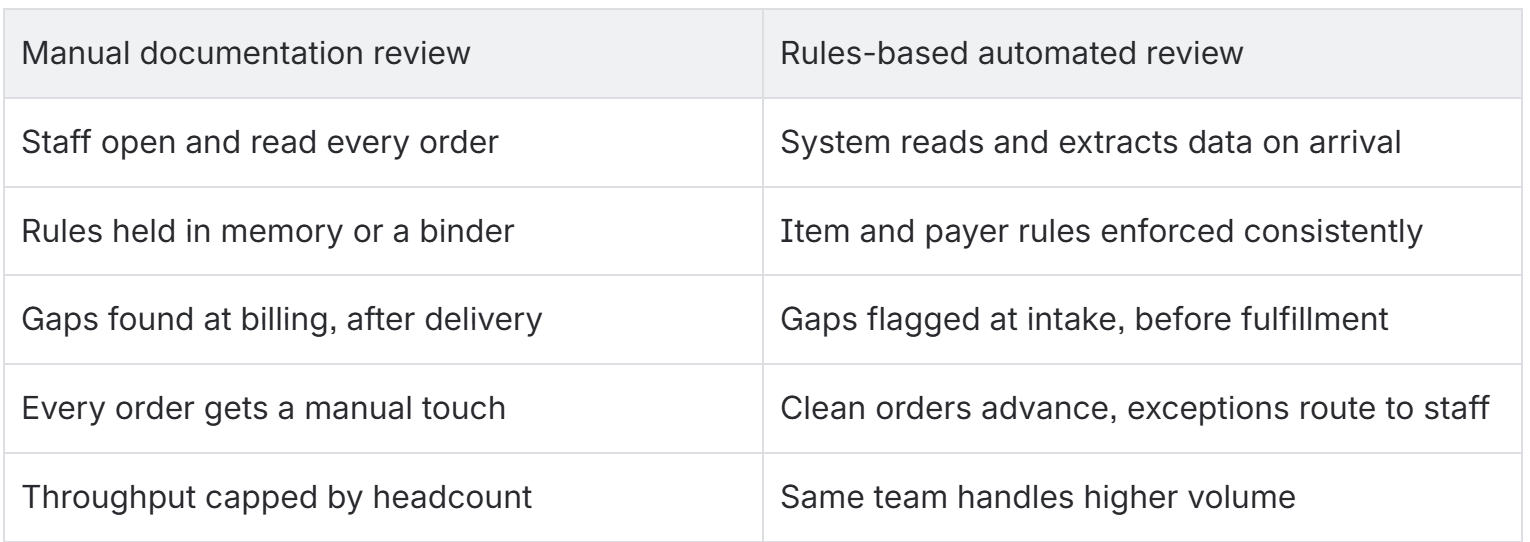
Automation confirms the SWO has its required elements, checks that documentation supports the item, verifies eligibility and benefits, identifies when prior authorization is needed, and holds anything incomplete for review. Clean orders move forward on their own. Staff spend their time on the exceptions that need judgment, like chasing a missing note or working a complex payer, instead of confirming orders that were already correct.
DME Documentation Requirements FAQs
What is the minimum documentation for a DME claim?
At a minimum, a valid standard written order, a medical record that supports medical necessity for the item, and proof of delivery. Many items also require a documented face-to-face encounter and prior authorization before fulfillment, and payers add their own requirements on top.
Do DME documentation requirements start at intake or billing?
They start at intake. Billing works with the condition of the order that intake created. If the order, medical necessity, authorization, and coding are validated at intake, the claim is clean before billing begins.
Why do complete-looking orders still get denied?
Because the documents have to agree with each other. An order, diagnosis, and payer policy that conflict will produce a denial even when every required document is present. Validation has to check consistency, not just presence.
Does automation replace the billing or intake team?
No. Automation validates and routes routine orders. People handle the exceptions: missing documentation outreach, referral-source coordination, complex payer calls, and appeals. The same team manages more volume with fewer manual touches.
Where does documentation automation deliver results fastest?
Start with your highest-volume or highest-denial categories, like CPAP, oxygen, or mobility. Those are where consistent validation removes the most rework.
Where to Start:
You don't need to automate everything at once. Work from your own data:
- Pull 60 to 90 days of denials and identify the documentation-related reasons.
- Rank them by volume and revenue impact.
- Trace each top pattern back to its upstream cause at intake.
- Configure validation rules at that point, starting with your worst category.
- Monitor first-pass clean claim rate and denial volume as the rules stabilize.
- Expand to the next category once the first set is holding.
Documentation requirements are not going away, and they keep getting more specific. The providers who stay ahead are the ones who validate the file once, at the source, so billing never inherits a problem it can't fix.
