

Bottom line: DME AR management is the work of getting billed claims paid and keeping aged receivables from turning into write-offs.
Most aging is an intake problem that surfaced late. Prevent the denials upstream, then work what remains by root cause instead of by age.
What is DME AR Management?
DME AR management is how a provider tracks, follows up on, and collects the money owed on claims that have already been billed. It covers the full path from claim submission to payment: watching the aging buckets, working denials, resubmitting corrected claims, filing appeals, and deciding what's worth chasing. The goal is a clean, current receivable, vs a growing pile of old claims nobody has touched.
The number most teams watch is days in A/R, along with how much of the balance sits past 90 and 120 days. Those numbers tell you whether cash is moving. They don't tell you why a claim is stuck, and that "why" is where the real work lives. A receivable that keeps aging is usually a workflow problem that started well before billing.
Why DME Receivables Age
Claims age for reasons that trace back upstream. A claim denied for a documentation gap can't be fixed until someone gathers the document that intake never captured. A claim missing prior authorization sits until the auth is chased down, if it can be recovered at all. A claim with a coding or modifier error has to be corrected and resubmitted, which resets the clock. In each case, the aging is the visible outcome of a defect that entered the workflow earlier.
The second driver is follow-up that depends on memory. When working aged claims means someone opening a worklist and deciding what to touch, the oldest and messiest claims get skipped in favor of the easy ones. The balance looks organized, but the claims most at risk of the timely filing limit are the ones sitting untouched. Billing can't recover revenue on a claim that quietly ages past the deadline.
What Should DME AR Management Prioritize?
Aging reports usually sort by date, which tells you a claim is old but not what to do about it. The more useful cut is by cause and by recoverability. A claim denied for a fixable coding error is a different task than a claim missing a document that may no longer exist, and both are different from a small balance where the cost to chase it exceeds what you'd collect.
Working A/R by cause means grouping the balance into the actions that resolve it: correct and resubmit, gather documentation and appeal, confirm eligibility and rebill, or write off and move on. That grouping also surfaces patterns. When the same denial reason shows up across dozens of aged claims, the receivable is telling you exactly which upstream check is failing, and fixing that check keeps the next wave of claims from aging the same way.
How Automation Improves DME AR Management
Rules-based automation attacks A/R from both ends. Upstream, it validates documentation, eligibility, authorization, and coding before the claim goes out, so fewer defects enter the receivable in the first place. Downstream, it categorizes denials, groups aged claims by cause, and prioritizes the ones with the most recoverable dollars and the nearest filing deadlines. Staff work a queue ordered by what will actually recover revenue instead of scrolling a flat aging report.
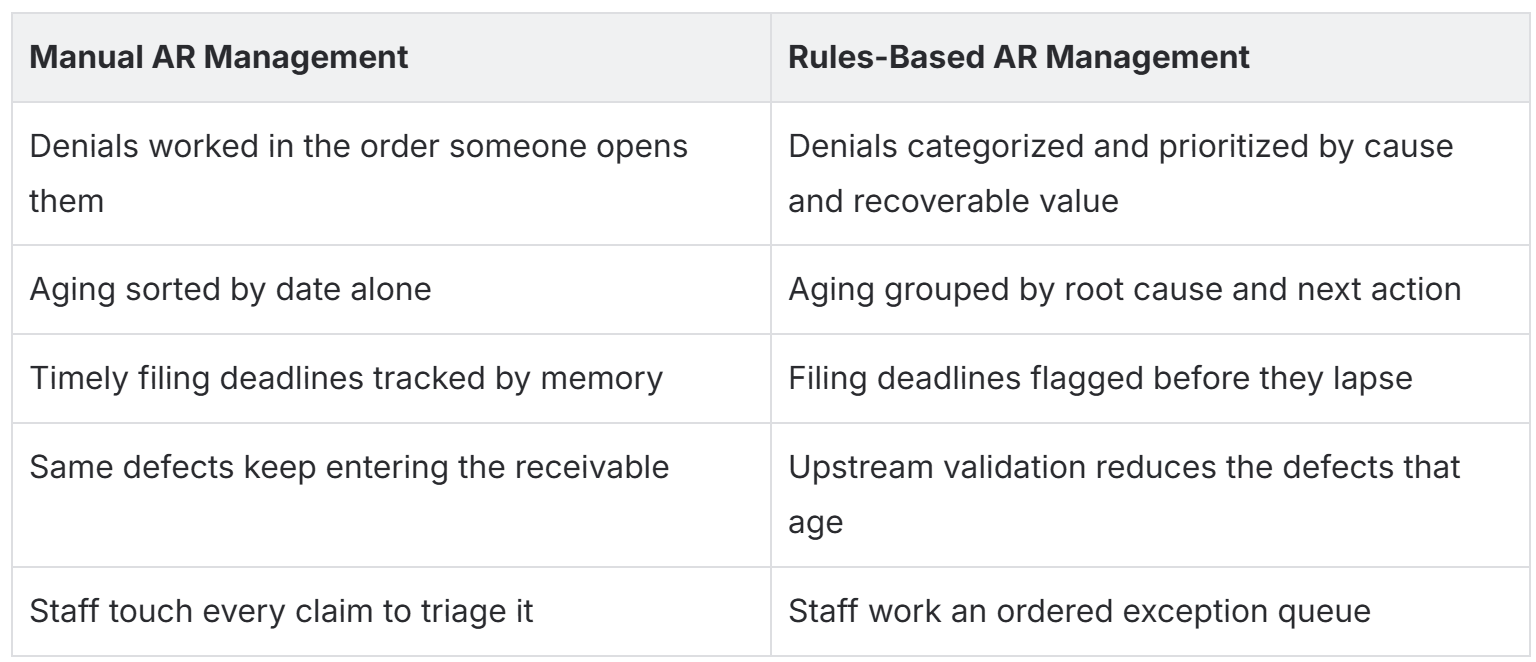
This layers into your existing system. If you run Brightree, the prioritization can drive WIP routing inside the worklists you already use, so aged claims surface in the order that protects recovery. A status tracker becomes a workflow engine only when the state changes are tied to validated conditions instead of a manual click. The result is throughput: the same billing team works a larger receivable with fewer manual touches per claim, and less of the balance slips into write-off.
DME AR Management FAQs
What is a good days-in-AR target for DME?
It depends on payer mix and product lines, so the more useful measure is the trend and the share of the balance past 90 and 120 days. Watch whether aged buckets are shrinking and whether the same denial reasons keep reappearing, since a stable or falling aged percentage matters more than a single benchmark number.
Why does DME AR age faster than teams expect?
Because most aging starts upstream. A documentation gap, a missing authorization, or a coding error at intake becomes a denial at billing, and the claim then sits until someone works it. The receivable is where upstream defects become visible.
Does improving AR management require replacing Brightree?
No. Denial categorization, aging prioritization, and upstream validation can run inside your current Brightree workflows as an added layer, not a platform swap.
Where does automated AR management pay off fastest?
In high-volume denial patterns and claims approaching the timely filing limit. Grouping those by cause and surfacing the most recoverable claims first tends to protect the most revenue in the least time.
Where to Start
You don't need to overhaul the receivable at once. Start where the dollars and the deadlines are.
- Pull your current aging and sort the balance past 90 days by denial reason, not just by date.
- Find the top denial patterns by volume and by recoverable dollars.
- Trace each pattern to its upstream cause, usually a documentation, eligibility, authorization, or coding gap at intake.
- Configure upstream validation for those causes so the next wave of claims doesn't age the same way.
- Group the existing aged balance by action: correct and resubmit, appeal, rebill, or write off.
- Route the recoverable claims to an exception queue ordered by value and filing deadline.
- Track days in A/R and the aged percentage, then expand once the patterns stabilize.
DME AR management isn't only about working the balance you already have. It's about closing the upstream gaps that keep refilling it, so the same team collects more and writes off less.
