
Operating a DME business is no small feat.
(Understatement, perhaps?)
In any climate, managing an efficient, scalable DME while serving patients well is an immense challenge. But the current environment is especially intense: increasing demand, a tightening labor pool, rising operational complexity, and ever-shifting legislation and payer requirements are putting immense pressure on DME suppliers.
Like many DME/ HME operators, you may be past the question of “How can we work harder?” and considering “Do we need extra help?”
Enter, delegation.
Here’s what you need to know: delegation doesn't necessarily mean handing operations over to a third party. This is good news, by the way!
DME/ HMEs can delegate TASKS - yes, those repetitive, rules-based, manual tasks your employees waste/ spend hours on - and give them to bots, allowing your people to spend more time on the work that actually requires human judgment, communication, and expertise.
Okay, let’s consider if YOUR operation may need some additional help. Jump right in.
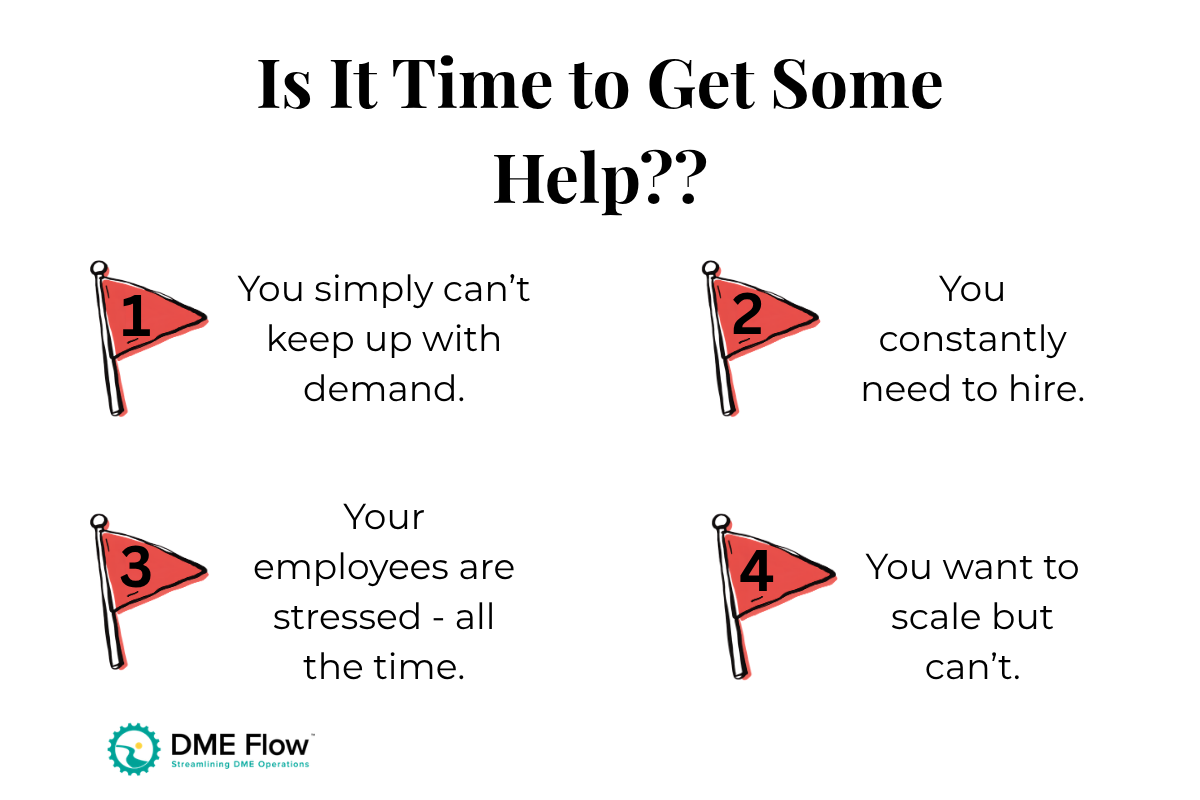
Your DME May Need Additional Help If…
1. You Can't Keep Up With Demand
Growth sounds like a good problem to have - until your team can't keep up with it.
More orders mean more intake. More patients mean more documentation. More volume means more eligibility checks, authorizations, follow-ups, billing tasks, and resupply opportunities.
If your team is constantly racing to keep up with yesterday's work, adding more volume may only make the problem worse.
And that can create a frustrating cycle:
More orders → more manual work → more employees needed → higher operating costs → more pressure to increase volume.
A scalable operation should be able to handle increased demand WITHOUT requiring a proportional increase in headcount.
If your DME is growing faster than your operational capacity, it may be time to delegate some of the work.
2. You Constantly Need to Hire
We won’t deny it… hiring IS sometimes necessary. But if you're continually adding employees simply to keep up with routine operational tasks, it's worth taking a closer look at why.
Wouldn’t it be better to do MORE with your SAME team?
Consider this. Many DME workflows contain highly repetitive processes:
- Entering information from orders
- Checking documentation
- Verifying insurance eligibility
- Routing tasks to the right employee
- Following up on outstanding information
- Checking order status
- Preparing claims
- Identifying missing information
- Managing resupply opportunities
Though undoubtably important, many of these tasks don't require a person to perform every step manually.
TLDR; this is a red flag: you’re hiring people to perform work that could be standardized and automated.
3. Your Employees Are Stressed (All the Time)
There is a difference between a busy team and an overwhelmed team. Busy employees have a lot to do. Overwhelmed employees feel like they can never catch up.
If your employees are constantly dealing with backlogs, interruptions, repetitive data entry, manual follow-ups, and administrative busywork, burnout can become an operational problem - not just an HR problem.
And, let’s be honest, stressed employees are more likely to make mistakes, leading to more rework and, sometimes, real, revenue-impacting consequences.
The question to consider is: “What can we take off the plates of my highly-capable, highly-overworked team?”
4. You Want to Scale - But Can't
Perhaps the clearest sign that it's time to rethink your operations is this: You have growth opportunities, but you're afraid to pursue them because you don't have the operational capacity to support them.
That's a serious problem.
Your growth shouldn't be limited by how many people you can hire, how quickly you can train them, or how many hours your existing employees can work. Read that again.
If adding 20% more business requires adding 20% more staff, your processes are not scalable.
The goal of delegation is not simply to make today's workload easier. It's to build an operation that can handle the workload of the future, too.
Okay, So What Does Delegation Look Like?
The idea of delegation is nice. But for many DME owners and operators, the actual process sounds expensive and time-consuming.
Nod if you’re thinking one of more of these things:
We don't have time to redesign our workflows.
We don't want to outsource important work.
Our processes are too complicated to automate.
Our employees already know how to do this.
If you nodded, that’s okay. These concerns are understandable.
But delegation doesn't have to mean handing your operations over to another company. It can mean letting bots handle the repetitive work while your people handle the work that requires people.
Think about your typical DME workflow. Not every one of those steps requires a human. Right? That's where automation can become the most high-value form of delegation possible.
Delegate the Work, Not the Responsibility
We should include one important distinction:
Automation doesn't mean removing people from your operation - it gives them freedom to do work only people can do.
Your employees should be spending their time on the things that benefit from human involvement, such as providing excellent service and solving complex, unpredictable problems.
Automation can take care of everything else.
So, Are You Ready to Dig Deeper?
If you resonated with any of the identifiers that your DME may need help, no shame. THIS blog is a good place to be.
The path forward is quite simple.
At DME Flow, we help DMEs automate the repetitive operational work that slows their teams down - from intake and order processing to billing, resupply, and revenue cycle workflows.
The goal? Helping DMEs do MORE with their same, great team.
