
What Should Complex Rehab Providers Expect from CRT Software?

CRT software manages complex rehab orders from referral through delivery: clinical evaluations, ATP involvement, configured quotes, prior authorization, manufacturer orders, and fittings. These orders run for weeks and pass through many hands, so the software's main job is to show where each order really stands, enforce the documentation sequence payers check, and flag stalled orders before they age.
What Is CRT Software?
Complex rehab technology (CRT) covers individually configured mobility equipment, such as power and manual wheelchairs with custom seating, positioning, and specialty drive controls, for patients with significant disabilities. CRT software is the workflow layer that runs those orders.
A standard DME order might involve one item and a few documents. A CRT order can involve a face-to-face exam, a specialty evaluation by a licensed clinician, an assistive technology professional (ATP) assessment, a quote with dozens of line items, prior authorization, a manufacturer build, and an in-person fitting. Each step depends on the one before it, and several involve people outside your organization. General order tracking struggles with that, so CRT teams can end up running the real workflow in spreadsheets beside their system of record.
How a CRT Order Moves Through the Workflow
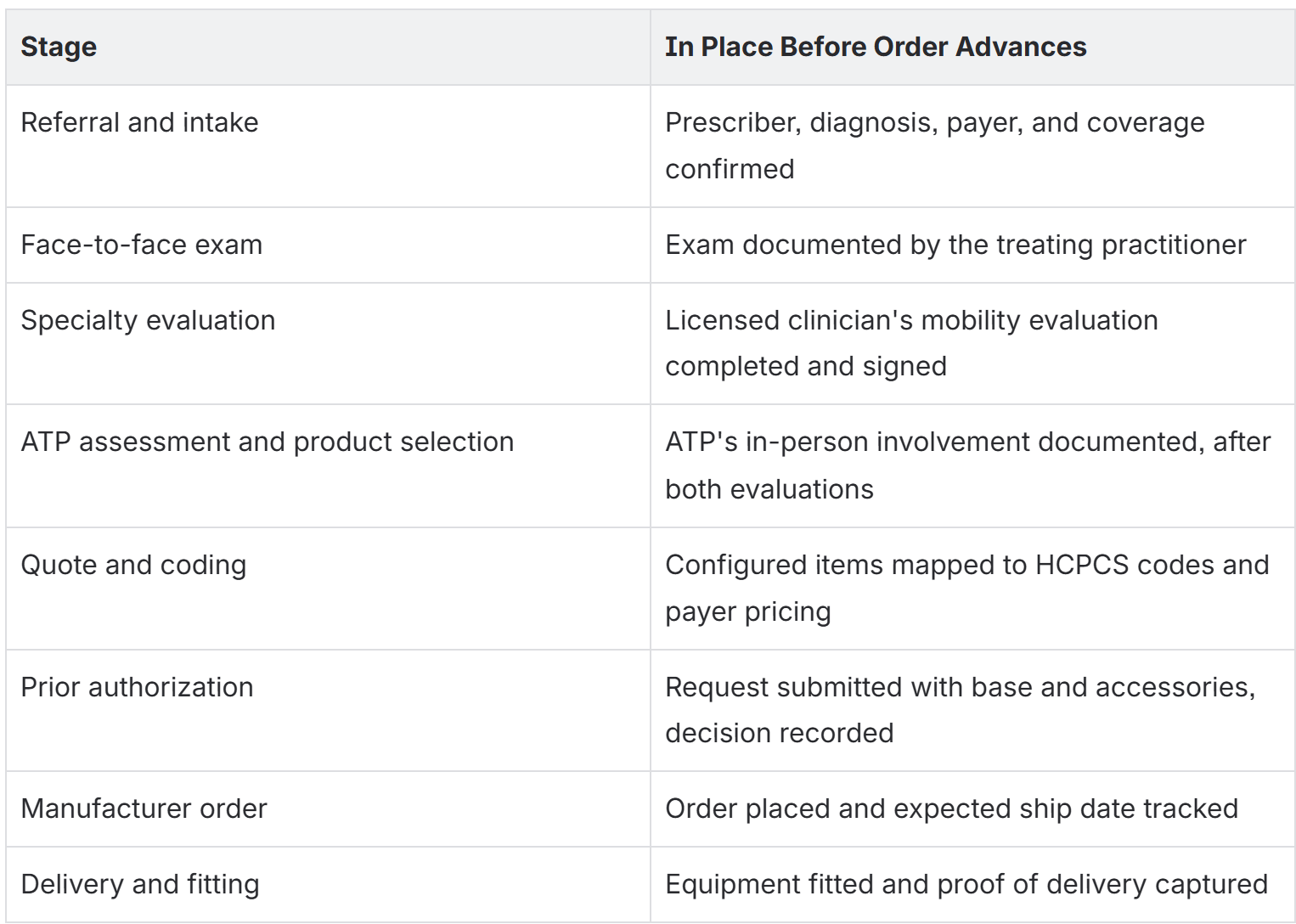
Most stalls happen at the hand-offs: waiting on a clinician's signed note, a corrected quote, a prior authorization decision, or parts. If status depends on someone updating a field, those waits stay invisible until a referral source calls to ask where the chair is.
Medicare Rules That Shape the CRT Workflow
Two sets of Medicare requirements make sequence and dates central to CRT software.
Rehab power wheelchairs, which include Group 2 chairs with power seating and all Group 3, 4, and 5 chairs, require a RESNA-certified ATP employed by the supplier to have direct, in-person involvement in wheelchair selection. Noridian's guidance says the ATP can't perform any part of the face-to-face exam or the specialty evaluation, and product selection can't begin until both are complete. Signing off on a form someone else completed doesn't count.
CMS also requires prior authorization nationwide for most power wheelchair codes, including Group 3 (K0848 through K0864). Accessories can be submitted on the same request as the base, and an affirmed decision stays valid for six months.
Together, those rules mean the dates on documents matter as much as their presence. An ATP note dated before the specialty evaluation is a sequencing problem. An affirmation that expires while parts are back-ordered can force a new request.
An Example: A Group 3 Power Chair Before Prior Authorization
Take a Group 3 power chair order with everything attached: the face-to-face note, the physical therapist's specialty evaluation, the ATP's assessment, and a 40-line quote. On a document checklist, it looks complete.
A date check shows a problem. The ATP's product-selection notes are dated three days before the specialty evaluation was signed. Software that validates sequence flags the order before the prior authorization request goes out, with the reason attached. The ATP repeats the selection visit after the evaluation and documents it, and the request is submitted with the corrected record.
Without that check, the problem tends to surface later, in a non-affirmed decision or a post-payment review, after weeks of work on the order.
How to Evaluate CRT Software
Ask each vendor to show these capabilities using one of your own recent orders:
- Order status tied to completed documents and dates, rather than manual stage updates
- Checks on document sequence and signature dates, beyond whether a file is attached
- Quote building that maps configured items to HCPCS codes and payer pricing
- Prior authorization packages that include base and accessories, with decisions and expiration dates tracked
- Manufacturer order and parts tracking linked to the patient order
- Alerts when an order sits in one stage past a set number of days
- Status visibility for referral sources without a phone call
- A separate workflow for repairs
CRT Software FAQs
Is CRT software different from general DME software?
In scope, yes. General DME software is built around high-volume, standardized orders. CRT orders are lower volume but longer, with more documents, more parties, and configured quotes, so they need stage tracking, sequence validation, and quoting tools that standard order entry usually doesn't provide.
Does CRT software require replacing Brightree?
It shouldn't. Look for software that works with your existing Brightree setup, reading patient and order data and writing back status and documentation, so Brightree remains the system of record.
Should repairs run through the same workflow as new orders?
No. CRT repairs have their own evaluation, quoting, and authorization steps, and a chair out of service is urgent for the patient. Repairs mixed into the new-order queue tend to wait behind longer jobs, so they need their own path and their own aging alerts.
Does CRT software help with non-Medicare payers?
It can, if payer rules are configurable. Medicaid plans and commercial payers set their own evaluation, authorization, and documentation requirements, so the software should let you define them by payer instead of hard-coding the Medicare process.
Where to Start
- List your open CRT orders and the date each entered its current stage.
- Find the stages where orders wait longest, and note why.
- Review the last 90 days of non-affirmed prior authorizations and denials for documentation or sequencing causes.
- Write down the checks that would have caught them.
- Bring one stalled order and one denied order to each software demo and ask the vendor to walk through how the system would have handled them.
The demo that matters is the one run on your own orders. If the software would have flagged your last few stalled chairs before anyone had to ask about them, it's worth a closer look.
