
Bottom line: the DMEPOS Master List 2026 updates arrived in two separate notices.
Membership on the Master List itself does not create a requirement. Only the Required Face-to-Face and Written Order Prior to Delivery List and the Required Prior Authorization List do, and both expanded this year, effective April 13 and October 28, 2026.
Check your active HCPCS against those two lists, not the Master List.
What is the DMEPOS Master List?
The Master List is CMS's inventory of DMEPOS items that could be subject to additional conditions of payment. It is a candidate pool, not a rulebook. Items land on it when they exceed a payment threshold and also appear in an OIG or GAO report, get flagged by the Comprehensive Error Rate Testing program, or show billing increases without an explanation.
The payment thresholds are set in regulation at an average purchase fee of $500 or an average monthly rental fee of $50, both adjusted annually for inflation. For 2026 those adjusted figures land near $614 for purchase and $62 for monthly rental.
Codes stay on the Master List for years once added, and CMS updates it by Federal Register notice. Nothing about that inclusion changes your documentation obligations on its own.
What Changed in the DMEPOS Master List 2026 updates?
CMS published two notices this year. Most operators configured for the first one and have not yet looked at the second.
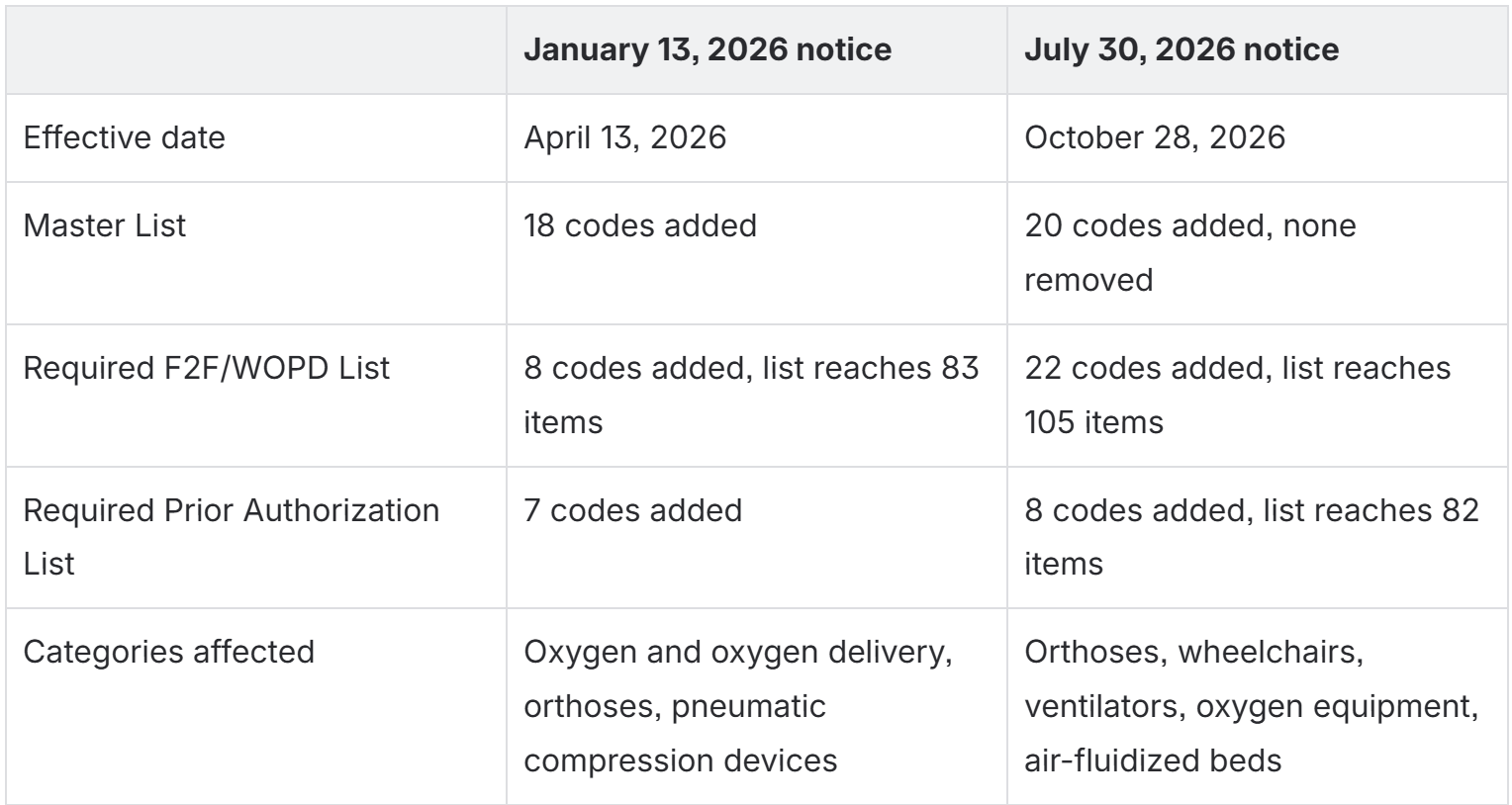
Effective October 28, 2026, the Master List itself contains 550 items.
The two lists that actually matter operationally are far smaller: 105 items requiring a face-to-face encounter and written order prior to delivery, and 82 requiring prior authorization.
Master List Membership Does Not Change Your Workflow
THIS is where providers waste effort.
A code appearing on the Master List creates no new documentation requirement, no prior authorization obligation, and no reason to change how the order is processed. CMS says plainly that suppliers need to take action only when an item also appears on one or both Required Lists.
What Master List inclusion does tell you is where CMS is looking. Continuous glucose monitor supplies were added in January, which is a reasonable signal for anyone running a CGM program even though nothing is required today.
Treat the Master List as your watch list and the two Required Lists as your rules. If your compliance process treats all three the same way, you are either adding work that Medicare does not require or missing the changes that carry denials.

Which Items Now Require a Face-to-Face Encounter and WOPD?
The January notice added eight oxygen and oxygen delivery codes to the Required F2F/WOPD List: E0424, E0431, E0433, E0434, E0439, E1390, E1391, and E1392.
For dates of service on or after April 13, 2026, those orders need a documented face-to-face encounter within the six months preceding the written order, and the written order has to reach you before delivery.
CMS pointed to oxygen's improper payment rate as the reason. The 2024 CERT data put it at 11.3%, roughly $81 million in projected improper payments.
The July notice added 22 more codes effective October 28, 2026, reaching into wheelchairs, ventilators, and air-fluidized beds. If you fulfill any of those categories, the six-month encounter window and the pre-delivery order requirement now govern those orders too. A nurse practitioner, physician assistant, or clinical nurse specialist can perform the encounter when it falls within their scope and they are treating the relevant condition.
Which Items Now Require Prior Authorization?
Seven codes joined the Required Prior Authorization List on April 13, 2026: five orthoses (L0651, L1844, L1846, L1852, L1932) and two pneumatic compression devices (E0651 and E0652). The DME MACs began accepting requests for the orthoses codes on March 30, ahead of the effective date.
Eight more codes take effect October 28, 2026. Four orthoses, one pressure reducing support surface, and one manual wheelchair base go nationwide on that date. Two upper limb orthoses phase in, starting with California, Florida, Michigan, and New York.
The operational difference between the two lists matters. A missing face-to-face note is a documentation defect you can sometimes cure. A missing prior authorization on a required code means the claim will not be paid, and the equipment may already be in the home.
The Prior Authorization Exemption Most Suppliers Have Not Configured
The CY 2026 Home Health PPS final rule created a temporary exemption from mandatory prior authorization for suppliers holding a provisional affirmation rate of 90% or better. The DME MACs notified suppliers of exemption status in early April, the first exemption cycle began June 1, 2026, and it runs annually after that.
Two details matter for how you manage it. Eligibility is calculated by PTAN and jurisdiction, so a multi-jurisdiction operation earns the exemption separately in each. And suppliers can opt out, which is worth considering if your internal workflow depends on the authorization record for downstream billing.
If you are exempt, your affirmation rate becomes a revenue asset rather than a compliance statistic. That changes how much attention the prior authorization queue deserves.
How to Operationalize the List Changes
The compliance work is straightforward. The workflow work is where providers fall behind.
- Pull your top 100 billed HCPCS codes and cross-reference them against both Required Lists, not the Master List
- Flag every affected code in your item master so intake sees the requirement at order entry
- Build a hard stop that prevents an affected order from advancing to fulfillment without the encounter date and the written order on file
- Validate the encounter date against the six-month window automatically rather than by eye
- Route prior authorization codes to a dedicated queue with the submission window and affirmation status tracked
- Recheck both lists after every Federal Register notice, since two arrived in 2026 alone
An order for E0431 that reaches delivery without a compliant encounter note is a denial that was fully preventable at intake. Billing cannot create documentation that nobody captured.
DMEPOS Master List 2026 Updates FAQs
Does a code on the DMEPOS Master List require prior authorization?
No. The Master List is a candidate pool. Requirements attach only when CMS selects a code for the Required Prior Authorization List or the Required F2F/WOPD List through a Federal Register notice.
What are the 2026 effective dates?
April 13, 2026 for the January notice, and October 28, 2026 for the July notice. Both apply to dates of service on or after those dates.
Which oxygen codes now need a face-to-face encounter?
E0424, E0431, E0433, E0434, E0439, E1390, E1391, and E1392, for dates of service on or after April 13, 2026. The encounter must fall within six months before the written order.
Do commercial payers follow these lists?
Not automatically. These are Medicare conditions of payment. Some commercial plans align their documentation standards with CMS on high-cost DMEPOS, but you have to verify plan by plan rather than assume.
Where to Start:
- Run a report of every HCPCS you billed in the last 12 months.
- Cross-reference it against the current Required F2F/WOPD List and Required Prior Authorization List.
- Flag the affected codes at the item level so the requirement surfaces at order entry.
- Add the encounter date and written order date as required fields on those orders.
- Configure a validation that blocks advancement when the encounter falls outside six months.
- Check your provisional affirmation rate and decide whether the exemption is worth pursuing.
- Set a recurring review tied to Federal Register notices rather than an annual calendar reminder.
