
Bottom line: DME order confirmation is the checkpoint that verifies an order is complete and correct before equipment ships and the claim is created.
It’s also crucial to note at DME order confirmation is the LAST point where a defect is cheap to fix.
When confirmation checks documentation, coverage, authorization, and coding consistently, preventable denials never enter billing.
Definitions matter, so that’s where we’ll start:
What is DME Order Confirmation?
DME order confirmation is the important review step that verifies an order is ready to fulfill and bill.
It happens after intake and before the equipment goes right out the door. The purpose is to confirm (no pun intended) that everything the claim will depend on is present and correct: the documentation, the patient's coverage and authorization, the item and coding, and the payer-specific requirements for that order.

Think of it as the last gate.
Once equipment ships and the claim is generated, fixing a problem means recovering revenue, reworking a claim, or arranging a return. Before fulfillment, the same problem is a phone call or a corrected field.
Essentially, order confirmation is the point where a team decides whether the order enters billing clean or carries a defect forward. It's a vital piece of the workflow to get right.
Why IS Order Confirmation the Last Cheap Place To Fix an Order?
The answer isn’t rocket science. Cost climbs the further a problem travels. It’s that simple.
A missing document caught at confirmation can be rectified with a quick request to the referral source. The same gap caught after delivery is a denied claim, equipment already in the patient's home, and a recovery effort that may not succeed.
The economics are clear:
- At intake: the cheapest place to catch a defect, but not everything is known yet
- At order confirmation: the last point before cost jumps, with the full order visible
- After fulfillment: expensive, because equipment is out and the claim is built
- At billing denial: most expensive, because staff now clean up a problem created upstream
Order confirmation matters because it sits at the moment when the order is complete enough to check fully and still early enough that fixing it is easy. Skip it, and every defect that slipped through intake becomes a downstream denial.
So, What Should You Verify During DME Order Confirmation?
A confirmation step is only as good as what gets confirmed. A quick glance that the order "looks right" is not confirmation. Thorough confirmation verifies the fields the claim will be judged on.
For example:
- Documentation is complete and supports medical necessity
- Coverage is active and the item is a covered benefit for the date of service
- Prior authorization is on file when the payer requires it
- HCPCS codes and modifiers match the item and the payer's rules
- Quantity and frequency fall within the plan's limits
- Proof of delivery requirements are set up correctly
- Any payer-specific requirements for that item are met
When these items are confirmed and recorded, billing receives an order it can submit without rework. When they are assumed rather than checked, the order may ship with a defect that surfaces later as a denial.
Sounds Time Consuming… And, Yes, Manual Order Confirmation Breaks Down
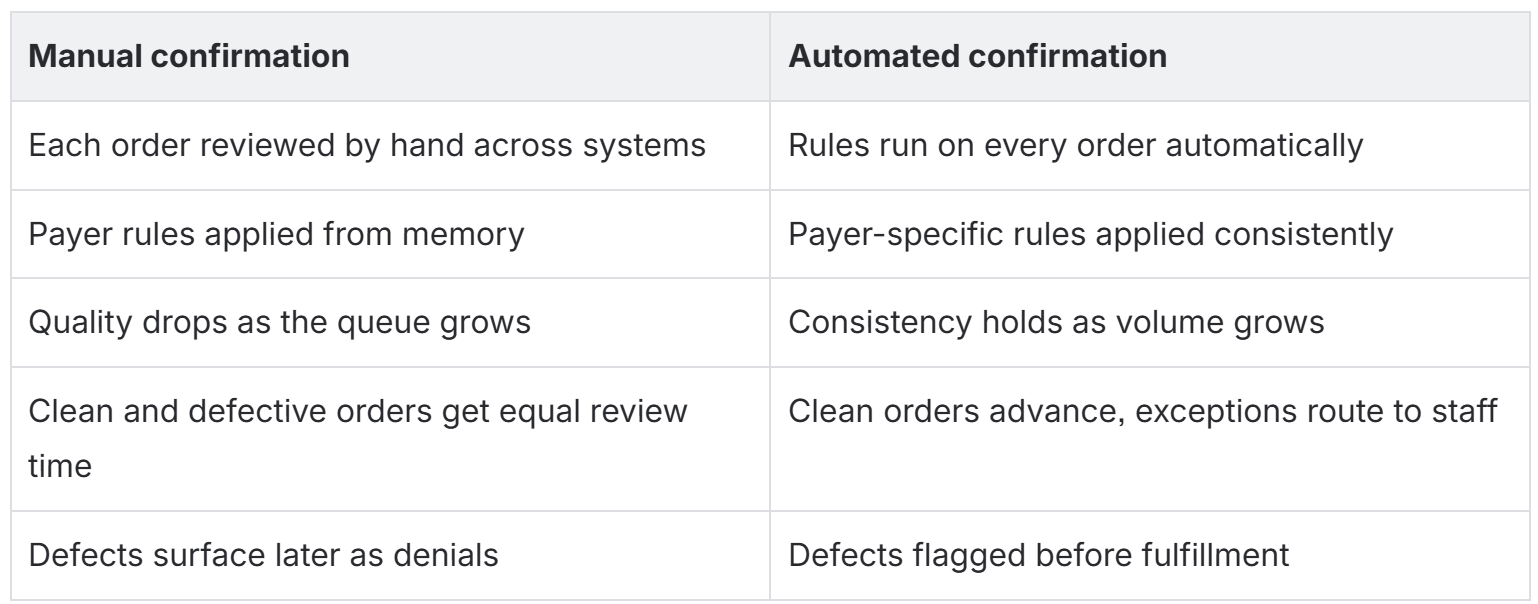
Manual confirmation works until volume outgrows the people doing it. Each order requires checking several systems and applying payer-specific rules from memory. At low volumes, a careful rep can do well. At higher volumes, the queue grows faster than anyone can review it carefully, and the pressure is always to clear orders, not to slow down.
That is where confirmation quietly degrades. A rep approves an order without re-checking the authorization because the queue is long. A coding mismatch slips through during a busy week. A quantity limit goes unverified on a resupply. None of this is carelessness. It is the predictable result of applying detailed, rules-based checks by hand across more orders than the step was designed for. The confirmation still happens on paper. It just stops catching things.
Enter: Automation, Designed to Confirm Orders at Scale
Rules-based automation applies the same confirmation checks to every order without depending on who is working the queue or how long it is. It verifies documentation completeness, confirms coverage and authorization, matches coding against payer rules, and checks quantity limits against defined criteria.
Orders that pass every check are confirmed and advance to fulfillment automatically. Orders that fail a check route to an exception queue with the specific reason attached, so staff work the actual problem instead of re-reviewing every order to find it. Automation handles the repeatable verification. People handle the judgment: chasing missing documentation, coordinating with referral sources, and resolving coverage that is genuinely unclear.
This is how throughput grows without proportional hiring. The same team confirms a larger order volume because they are no longer reviewing clean orders one at a time.
Human attention can shift to exceptions that actually need a person. And because confirmation is tied to validated conditions, the order's status reflects reality rather than the last manual click. This layers onto existing Brightree workflows rather than replacing them.
Manual Order Confirmation VS Automated Confirmation
DME Order Confirmation FAQs
What is DME order confirmation?
It is the checkpoint that verifies an order is complete and correct before equipment ships and the claim is created. It confirms documentation, coverage, authorization, coding, and payer-specific requirements while a problem is still cheap to fix.
How is order confirmation different from intake?
Intake captures and starts the order. Confirmation verifies the completed order just before fulfillment, when the full picture is visible. Intake sets the order up; confirmation is the last check that it is actually ready to ship and bill.
Does order confirmation prevent denials?
It prevents the denials caused by defects that would otherwise ship with the order: missing documentation, unmet authorization, coding mismatches, and exceeded quantity limits. Catching these before fulfillment stops them from becoming claims that deny.
Does automating confirmation require replacing Brightree?
No. Automated confirmation layers rules-based validation and exception routing onto existing Brightree workflows. Brightree stays the system of record; automation makes the confirmation step consistent and ties order status to validated conditions.
Can a small DME team automate order confirmation?
Yes. Lean teams often benefit most, because manual confirmation is where a small staff loses the most time. Automation lets the same team confirm more orders without adding people to keep pace.
Where to Start:
You do not need to automate every check at once. Start where defects are slipping through and costing the most.
- Pull 60 to 90 days of denials and sort by reason.
- Identify denials caused by defects that should have been caught at confirmation.
- Rank those patterns by volume and revenue impact.
- Define the confirmation checks that would have caught the top patterns.
- Configure those checks as rules, starting with your highest-volume payers and items.
- Route failures to an exception queue with the reason attached.
- Monitor results, then expand the checks once the first set is stable.
Order confirmation is the last inexpensive place to fix an order. Making that check thorough and consistent is one of the most direct ways to reduce denials without adding staff.
