
Bottom line: DME eligibility verification automation confirms benefit-level coverage before delivery and rechecks it on every rental and resupply cycle.
Plan-level active status does not tell you whether the item is covered, what the patient owes, or whether authorization applies. Automation runs those checks on every order so staff work only the exceptions.
Instead of needle in a haystack, its needle-without-any-hay-around.
Let’s explore more.
What IS DME Eligibility Verification Automation?
DME eligibility verification automation submits eligibility inquiries, parses the responses into structured benefit data, compares that data against the ordered item, and routes discrepancies to an exception queue without a coordinator opening a payer portal for every patient.
Most of it runs on standard 270 and 271 eligibility transactions through a clearinghouse or direct payer connection, with Medicare handled through HETS. The automation layer sits on top of those responses, reading what came back, deciding whether the order can proceed, and recording the result against the patient's insurance record.
The value is consistency.
Every order gets checked, at the right depth, and again before each billing cycle on recurring patients. That's the part manual workflows cannot sustain at volume.

Why Plan-Level Eligibility is Not Enough…
An active coverage response tells you the patient has insurance. It doesn't tell you whether the plan covers the item you're about to deliver.
Benefit-level verification answers the questions that actually determine whether you get paid:
- Does the plan cover this HCPCS category, and as a rental or a purchase
- Is there a DME-specific deductible, and how much of it remains
- What is the coinsurance, and is there a benefit maximum
- Are you in network for this plan and this product line
- Does the plan require prior authorization for this item
- Are there quantity limits or frequency limits on resupply
- Is there a secondary payer, and is the coordination of benefits order correct
Confirming active status and stopping there is how orders get delivered against coverage that excludes the item. The claim denies, the equipment is already in the home, and the balance moves to the patient or to write-off.
Where Does Eligibility Verification Break in Most DME Workflows?
The failure points are consistent, and most of them are timing problems rather than knowledge problems:
- Verification happens after the delivery is scheduled, so a coverage problem surfaces too late to stop the truck
- Coverage is confirmed once at intake and never rechecked on a 13-month rental
- A patient switches Medicare Advantage plans and the old plan stays on the account
- Medicaid coverage lapses at redetermination and monthly resupply keeps billing
- Deductibles reset on January 1 and patient balances arrive without warning
- The 271 response comes back thin, so a coordinator moves on without calling the payer
- Results live in a coordinator's notes rather than structured fields anyone can query
Each one produces the same outcome. Billing works a denial for a coverage condition that was knowable before delivery.
What Does DME Eligibility Verification Check?
Automation is effective wherever the criteria are already defined.
For eligibility, that covers most of the routine work:
- Active coverage and effective dates against the intended delivery date
- Benefit category coverage for the ordered HCPCS
- Deductible remaining, coinsurance, copay, and out-of-pocket status
- Network status for the servicing provider and location
- Prior authorization indicators returned by the payer
- Quantity and frequency limits relevant to resupply
- Secondary payer presence and coordination of benefits order
- Plan changes detected on re-verification, and re-verification timing tied to rental months and resupply cycles
Orders that clear route to fulfillment. Orders that fail route to an exception queue with the specific condition named, so the coordinator knows whether to call the payer, contact the patient about financial responsibility, or start a prior authorization.
Manual VS Automated Eligibility Verification
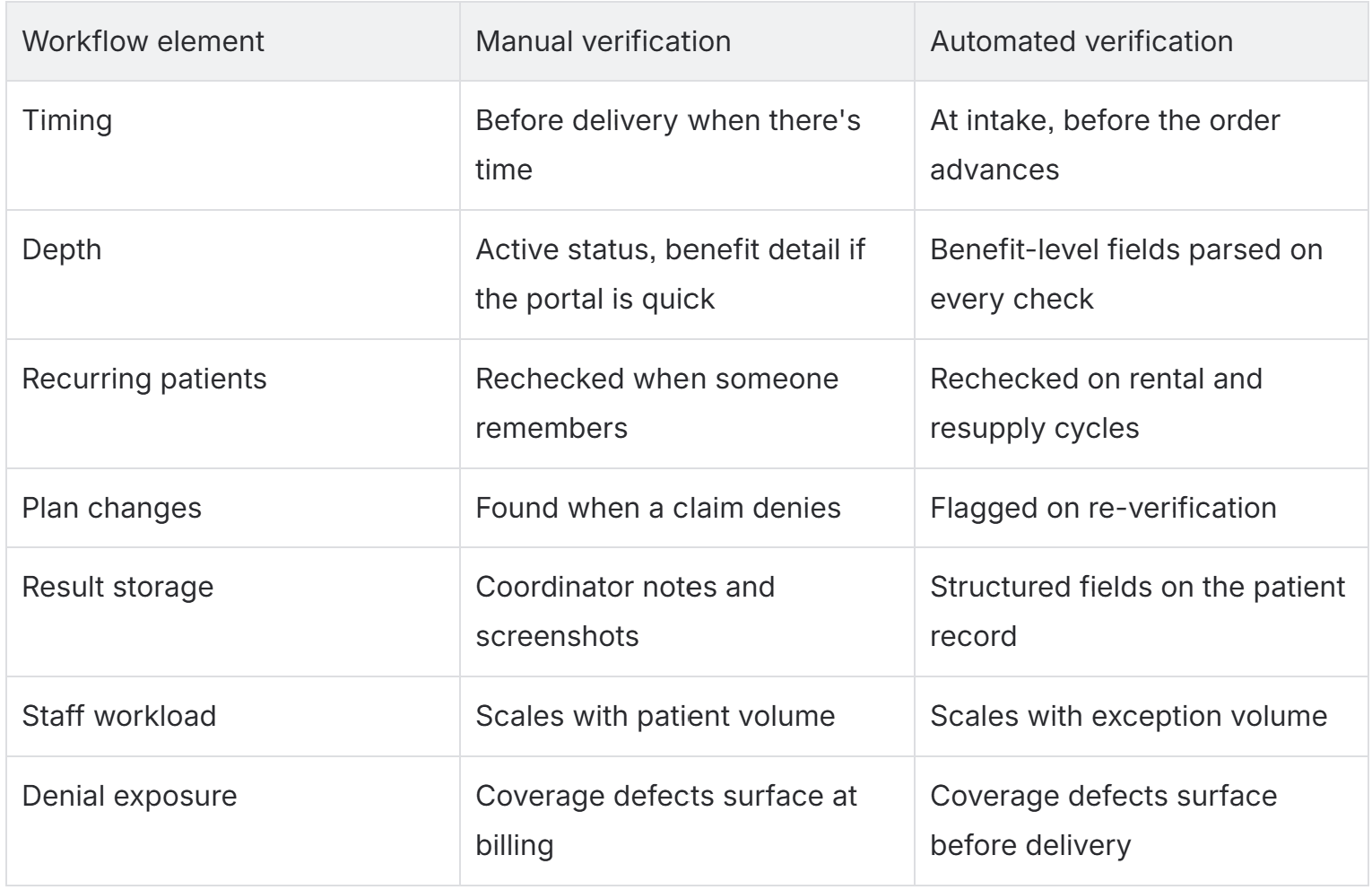
Why Rental and Resupply Need Re-Verification
One-time verification works for a one-time purchase. It fails on anything you bill more than once.
A capped rental bills for months against coverage that was confirmed on day one. A CPAP resupply patient bills every cycle for years. In both cases, the coverage that justified the first claim may not exist by the tenth. Plans change during annual enrollment, Medicaid eligibility lapses at redetermination, and patients move between employers and plans without telling you.
Manual re-verification across an active rental and resupply population is not realistic. The math doesn't work, so it gets skipped, and the skipped checks show up as denials on cycles nobody was watching. Automated re-verification runs the population on a schedule and surfaces only the accounts where something changed.
Humans Are Still Needed, Though…
Automation handles the payers that return usable structured data. Staff keep the rest, and the rest is real work. Plans that return thin benefit detail still need a portal check or a call.
Coverage ambiguity, where the policy language doesn't clearly address the item ordered, needs someone to read it and decide.
Coordination of benefits research on multi-payer accounts is judgment work, as is any appeal where coverage was in force and the payer says otherwise.
Patient conversations belong here too. Explaining a deductible, coinsurance, or an ABN to someone who expected full coverage is not work you want handled by a template.
Automating routine verification makes these conversations the job instead of the interruptions between hundreds of routine checks.
How To Measure Success (This Is Important)
Start with the percentage of orders that had benefit-level verification completed before delivery, not just active status confirmed.
Then track denial volume tied specifically to coverage, eligibility, and coordination of benefits, since that's the category automation should move.
Patient balances written off after delivery on non-covered items tell you whether the depth of verification is adequate.
The fourth measurement is the one operators forget: what percentage of your active rental and resupply population was re-verified in the current cycle.
If verification coverage improves but eligibility denials hold steady, you're confirming active status without confirming benefit detail.
DME Eligibility Verification Automation FAQs
What does DME eligibility verification automation actually automate?
Submitting eligibility inquiries, parsing benefit responses into structured fields, comparing coverage against the ordered item, scheduling re-verification on recurring patients, and routing exceptions. It does not replace payer calls for plans that return incomplete data.
Does it require replacing Brightree?
No. Verification results write back to the patient and insurance records in Brightree, and the automation determines whether the order can advance. Brightree remains the system of record.
How does it reduce denials?
By moving the coverage decision ahead of delivery and repeating it before each billing cycle. A coverage defect caught at intake costs a phone call. The same defect caught at billing costs a denial, an appeal, and sometimes the equipment.
Can eligibility verification be fully automated?
Not for every payer. Response completeness varies, and some plans return little usable benefit detail. A realistic implementation automates the payers that support it and routes the rest to staff with the inquiry already submitted.
Where to Start:
- Pull your last 60 to 90 days of denials and isolate the eligibility and coverage categories.
- Rank the payers driving that volume.
- Check which of those payers return usable benefit detail on a 271 response.
- Automate verification for those payers first, at intake, before the order advances.
- Add scheduled re-verification for your active rental and resupply population.
- Route everything else to an exception queue with the unmet condition named.
- Track verification completion and eligibility denials for a full billing cycle, then expand payer coverage.
- OR get in touch with DME eligibility automation experts, and we can walk you through the process, step-by-step.
