
Bottom line: DME billing offshore reduces labor cost on paper. In practice, it shifts billing complexity to a team without full operational context, introduces compliance exposure, and removes visibility from your revenue cycle.
In-house automation addresses the same cost problem by removing manual work from your existing team rather than outsourcing it, and it does so with better claim accuracy, more control, and no handoff risk.
Why Do DME Providers Consider Offshore Billing?
The case for DME billing offshore is straightforward. Billing labor is expensive. Trained billing staff are difficult to find and retain. Offshore teams, typically based in the Philippines, India, or Latin America, offer significant hourly rate reductions for claim submission, denial management, and payment posting work.
For a DME operation processing high claim volume with a large billing team, the cost reduction on paper can be substantial. That calculation is what drives the conversation.
The problem is that the paper calculation omits the cost of what goes wrong.

What DME Billing Offshore Actually Costs
Offshore billing introduces a set of operational and compliance costs that do not appear in the hourly rate comparison.
Payer rule complexity. DME billing is payer-specific in ways that require deep, current knowledge of LCD criteria, modifier logic, prior authorization requirements, and documentation standards that vary by payer and product category. Offshore teams work from general billing training and scripted workflows. Nuanced payer requirements that experienced in-house billers navigate through institutional knowledge become errors in an offshore environment.
Compliance exposure. DME billing involves protected health information governed by HIPAA. Offshore billing arrangements require Business Associate Agreements and security protocols that many offshore vendors provide in contract language but do not uniformly enforce in practice. Audit exposure and breach liability remain with the DME provider regardless of where the billing work occurred.
Communication lag. When a claim requires clarification, a payer call, or a documentation request, offshore teams escalate through communication chains that add time to resolution. Denials that an in-house biller would resolve in a single payer call accumulate in aging queues waiting for guidance. A/R cycles extend.
Visibility loss. In-house billing provides operational intelligence. Your billing team sees denial patterns, payer behavior changes, and documentation gaps that inform how intake and ordering processes should be adjusted. Offshore billing returns reports. It does not return the contextual knowledge that improves upstream workflow.
Common hidden costs of DME billing offshore:
- Training ramp time each time offshore team members turn over
- Escalation delays on denials requiring payer calls or clinical context
- Denial rates that run higher than in-house benchmarks due to payer complexity gaps
- Compliance management overhead to maintain HIPAA-compliant data handling protocols
- Management time required to oversee offshore team performance and quality
What In-House Billing Actually Costs Without Automation
The reason DME providers look offshore is real. In-house billing without automation is expensive in ways that go beyond salary.
Staff spend significant time on steps that do not require billing expertise. Checking claim status. Confirming documentation is attached. Correcting modifier errors that should not have reached submission. Managing resupply cycles manually. Researching denials that were preventable at intake.
These are not billing decisions. They are process execution tasks that consume billing capacity and inflate the effective cost of in-house operations. When that cost is compared to offshore hourly rates, offshore looks attractive.
The comparison changes when automation removes those tasks from your in-house team.
How Automation Makes In-House Billing Competitive
Rules-based automation applied to your DME billing workflow removes the manual, repeatable steps that inflate in-house billing costs without adding billing value.
Documentation validation runs at intake automatically. Eligibility confirms before fulfillment. Coding and modifier logic applies from configured rules rather than manual review. Pre-submission edits run before claims leave the system. Denial reason codes categorize and route automatically with priority logic applied.
Your in-house billing team stops spending time on preventable corrections and starts managing exceptions, complex denials, and high-value recovery cases. The same team handles higher claim volume. The cost per clean claim decreases without sending work offshore.
What automation changes about the in-house vs offshore cost comparison:
- Manual claim preparation steps that drove headcount requirements are removed from in-house workflows
- First-pass clean claim rates improve, reducing the denial management volume that required additional staff
- Resupply billing runs automatically, removing a significant manual workload from billing queues
- In-house staff retain payer-specific knowledge that improves over time rather than cycling through offshore training
- Compliance risk stays inside your operational control rather than distributed across an external vendor
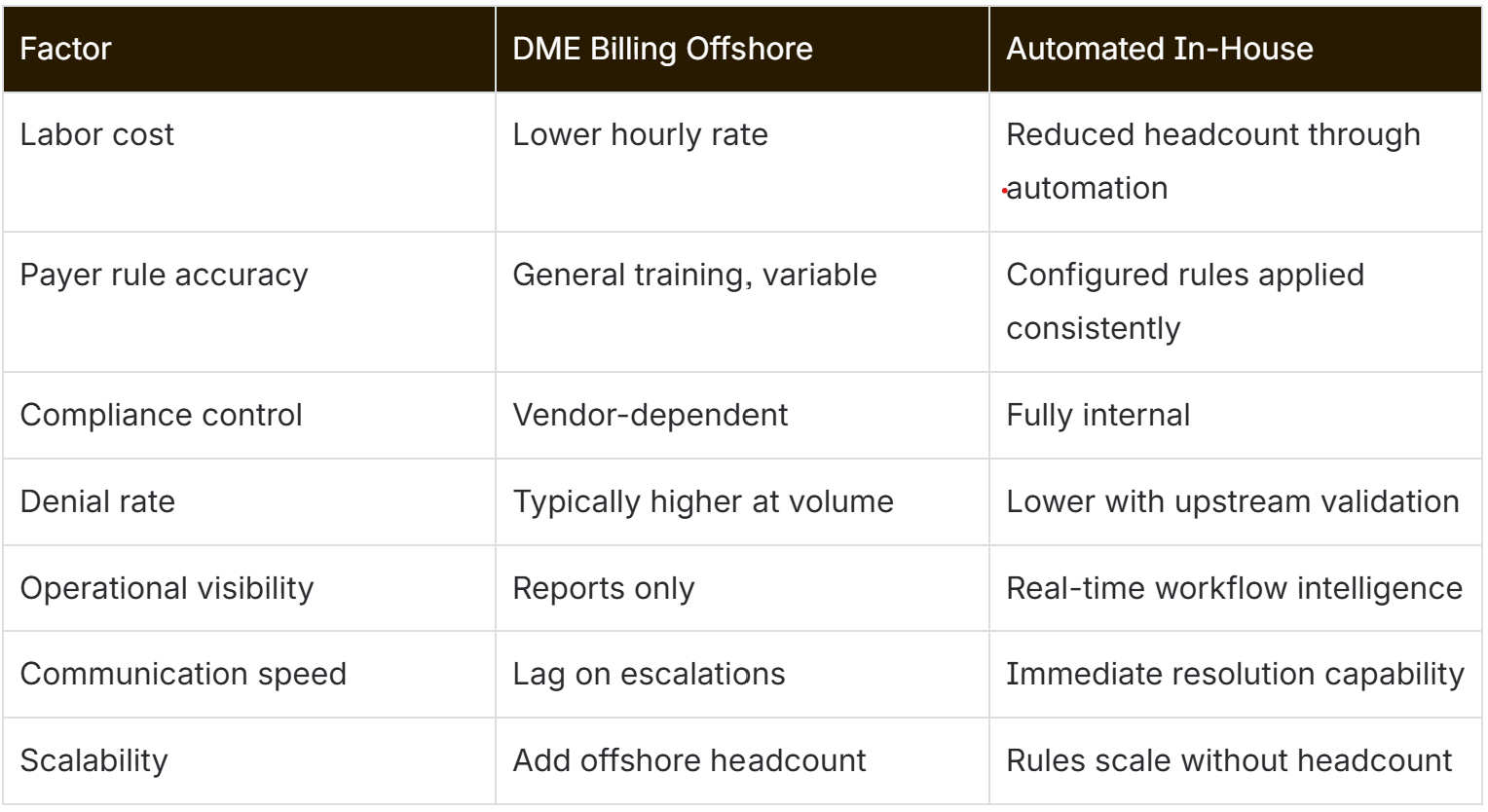
In-House vs Offshore: What Each Model Actually Delivers
DME Billing Offshore FAQs
Is DME billing offshore a good idea?
It depends on what problem you are trying to solve. If the problem is labor cost, offshore reduces it on paper but introduces payer complexity gaps, compliance exposure, and visibility loss that offset the savings in many DME billing environments. If the problem is operational efficiency, automation addresses it more directly without the tradeoffs.
What are the risks of offshore DME billing?
The primary risks are payer-specific billing errors driven by complexity gaps, HIPAA compliance exposure from offshore data handling, A/R cycle extension from communication lag on denial resolution, and loss of operational intelligence that in-house billing provides. These risks vary by vendor but exist structurally in offshore arrangements.
How does automation make in-house DME billing more cost-effective?
By removing the manual, repetitive steps that inflate in-house billing labor costs without adding billing judgment or expertise. Documentation validation, coding rules, pre-submission edits, and denial routing run automatically. Staff manage exceptions and complex cases rather than routine processing, reducing effective cost per clean claim without reducing billing quality.
Can a small DME billing team handle high volume with automation?
Yes. The constraint on in-house billing team capacity is typically the volume of manual processing steps required per claim, not the complexity of billing decisions. Automation removes the processing steps. The same team applies billing expertise at higher volume with fewer errors than a larger manual team.
The Right Question to Ask
The offshore vs in-house decision is often framed as a cost question. The better frame is a control question.
Offshore billing trades cost for control. You get lower hourly rates and give up visibility, compliance control, and payer-specific accuracy. In-house automation reduces cost while retaining control. You keep the institutional knowledge, the operational visibility, and the compliance structure your DME billing operation depends on.
Before committing to an offshore arrangement, the question worth asking is whether automation applied to your current in-house operation produces the same cost reduction without the tradeoffs. For most DME providers operating in complex payer environments, it does.
